
Sprout Social vs. Heropost: Which Social Media Tool Should You Choose in 2026?
 Heropost Team·Apr 11, 2026·8 min read

Introduction
Sprout Social is one of the most well-known names in enterprise social media management. Heropost is a growing challenger built specifically for agencies and growing teams. Both offer scheduling, analytics, and multi-account management—but they target different budgets, team sizes, and operational complexities.
If you are evaluating both, the decision usually comes down to one question: are you buying an enterprise platform with a premium price tag, or a professional-grade tool that delivers agency-quality features without the enterprise cost?
Here is the honest comparison.
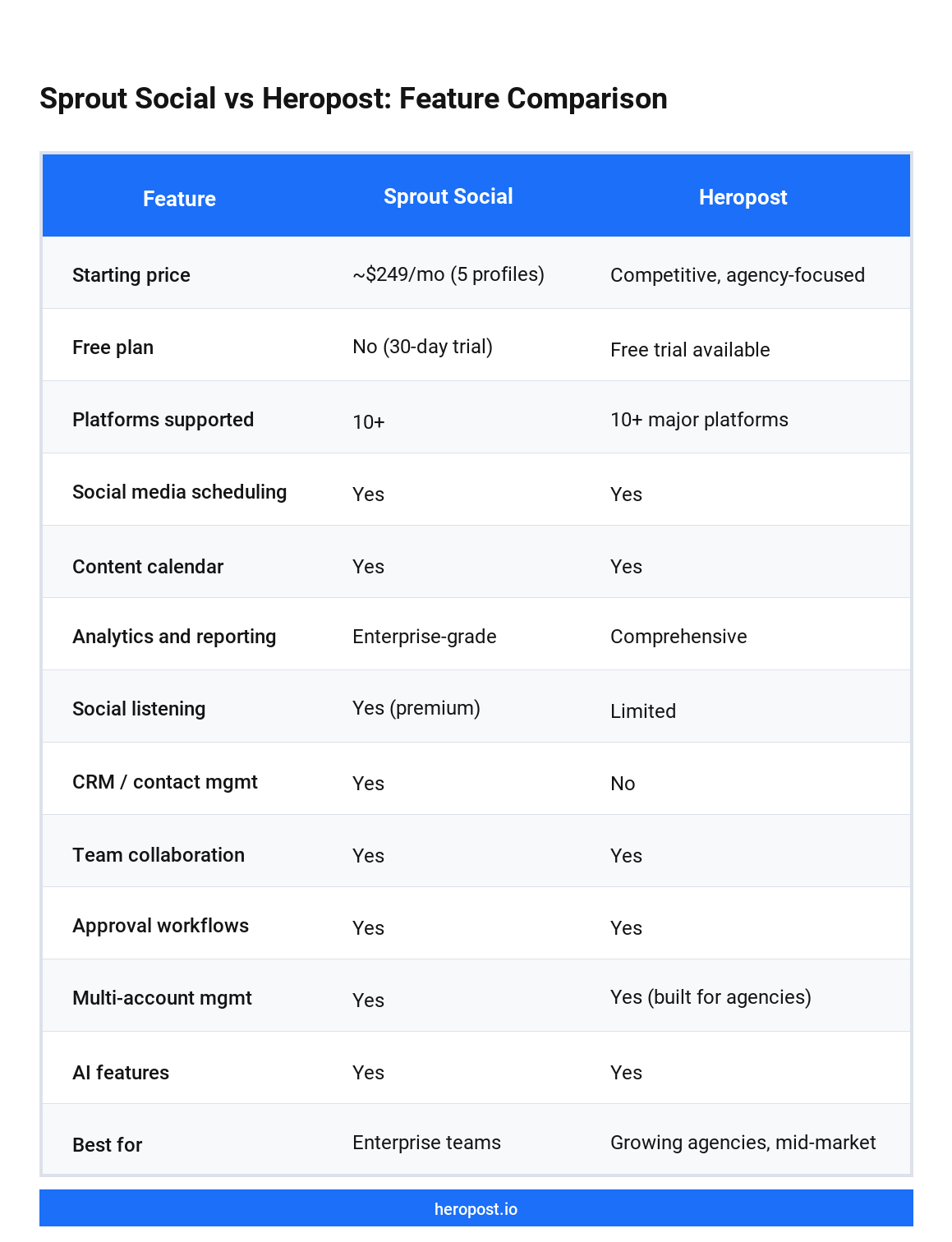
Quick Comparison
| Feature | Sprout Social | Heropost |
|---|---|---|
| Starting price | ~$249/mo (Standard, 5 profiles) | Competitive pricing, agency-focused |
| Free plan | No (30-day trial) | Free trial available |
| Platforms supported | 10+ | 10+ major platforms |
| Social media scheduling | Yes | Yes |
| Content calendar | Yes | Yes |
| Analytics and reporting | Enterprise-grade | Comprehensive |
| Social listening | Yes (premium) | Limited |
| CRM / contact management | Yes | No |
| Team collaboration | Yes | Yes |
| Approval workflows | Yes | Yes |
| Multi-account management | Yes | Yes (built for agencies) |
| AI features | Yes | Yes |
| Best for | Enterprise teams, large agencies | Growing agencies, mid-market teams |

Sprout Social: The Enterprise Standard
Sprout Social has positioned itself at the top of the social media management market since 2010. In 2026, it is the platform of choice for enterprise marketing teams, large agencies, and brands that need the deepest feature set money can buy.
What Sprout Social does exceptionally well:
Social listening at scale. Sprout’s social listening tools let brands monitor mentions, brand sentiment, competitive conversations, and trending topics across platforms in real time. For large brands managing reputation at scale, this is a critical capability. This is Sprout’s clearest differentiation from most mid-market tools.
CRM and contact management. Sprout’s “Smart Inbox” consolidates all social conversations across platforms, and its contact profiles let teams track the history of every customer interaction. For brands treating social media as a customer service channel, this is enormously valuable.
Advanced analytics and reporting. Sprout’s reporting suite is among the deepest in the category—custom report builders, competitive benchmarking, paid social performance, and presentation-ready exports. Brands that need to report social ROI to C-suite stakeholders find Sprout’s reporting the most polished available.
Enterprise workflow management. Approval workflows, task assignment, team productivity analytics, and integration with tools like Salesforce, Zendesk, and HubSpot make Sprout the most integration-rich option in its class.
Where Sprout Social falls short:
Price. This is Sprout’s most significant barrier. The Standard plan starts at approximately $249/month for 5 social profiles—and that is just the entry point. The Professional plan ($399/month) and Advanced plan ($499/month) quickly become the norm for agencies with real feature requirements. For most growing agencies and mid-market teams, this price level is simply out of reach.
Cost scaling. Sprout charges per user and per social profile, so costs scale aggressively as your team grows. An agency with 10 users managing 50 client accounts faces a very significant monthly bill.
Overkill for many use cases. Sprout is built for enterprise complexity. For agencies managing 10-30 client accounts without requiring CRM functionality or advanced social listening, paying Sprout’s prices for features they will never use is poor ROI.
Who should use Sprout Social?
Large enterprise brands, agencies with enterprise clients requiring deep social listening and CRM integration, and marketing teams where the analytics reporting directly supports C-suite reporting and strategic decisions. If your organization has the budget and the use case, Sprout is excellent.
Heropost: Professional Grade Without Enterprise Pricing
Heropost was built with a clear target user in mind: the growing social media agency or marketing team that needs professional-grade tools—multi-account management, team collaboration, approval workflows, comprehensive analytics—without paying enterprise prices for enterprise complexity they do not need.
What Heropost does particularly well:
Multi-account management efficiency. Heropost’s dashboard is purpose-built for managing many client accounts simultaneously. The experience of switching between clients, viewing cross-account schedules, and executing bulk actions across accounts is significantly smoother than what Sprout offers at its entry price point. For agencies where this operational efficiency is daily work, the difference is material.
Practical team collaboration. Approval workflows, team role assignments, and client-facing content review are built into Heropost’s core workflow—not gated behind premium tiers. For the typical agency workflow (writer creates → account manager reviews → client approves → publishes), Heropost’s collaboration features are fully functional without upgrading.
Comprehensive analytics. Heropost’s analytics dashboards are designed to be client-presentation-ready—visual, clear, and organized around the metrics clients actually care about. They do not reach the raw depth of Sprout’s enterprise reporting suite, but for most agency client reporting needs, they are more than adequate.
Scalable pricing. Heropost’s pricing structure is designed to remain manageable as your agency scales its client roster—you are not hit with per-user and per-profile charges that compound aggressively the way Sprout’s do.
Where Heropost has limitations compared to Sprout:
Social listening. Sprout’s social listening capabilities are significantly more developed than Heropost’s. For clients who need brand sentiment monitoring, competitive listening, or reputation management at scale, Sprout has a clear advantage.
CRM and customer service integration. Sprout’s Smart Inbox and contact management features are enterprise-grade customer service tools. Heropost is focused on content scheduling and publishing—it does not replicate Sprout’s CRM functionality.
Integrations. Sprout integrates with Salesforce, Zendesk, HubSpot, and dozens of other enterprise tools. Heropost’s integration library is growing but not at that breadth.
Head-to-Head: Key Decision Factors
Price winner: Heropost — by a wide margin
Sprout starts at $249/month for 5 profiles. Heropost delivers professional agency features at a fraction of the cost. For most growing agencies and mid-market teams, this difference is the deciding factor.
Analytics winner: Sprout (enterprise) / Heropost (agency-practical)
Sprout’s reporting suite is deeper for enterprise needs. Heropost’s analytics are well-designed for agency client reporting without the complexity.
Social listening winner: Sprout
This is Sprout’s clearest differentiation. If social listening is a core requirement, Sprout is the right choice.
Multi-account management winner: Heropost
Heropost was specifically designed for this use case. The operational UX for managing many client accounts is stronger.
Team collaboration winner: Tie at their respective price points
Both offer solid approval workflows and team management. Heropost delivers this at a significantly lower price.
CRM / customer service winner: Sprout
Sprout’s Smart Inbox and contact profiles are enterprise-grade customer service tools that Heropost does not replicate.
Which Tool Is Right for You?
Choose Sprout Social if:
– You are an enterprise brand or large agency with meaningful budget
– Social listening and brand monitoring are core requirements
– You need CRM functionality and integration with Salesforce, HubSpot, or Zendesk
– Your C-suite requires the most polished, customizable analytics reporting available
Choose Heropost if:
– You run a growing social media agency managing multiple client accounts
– Professional features (scheduling, analytics, approvals, multi-account management) are required but at reasonable prices
– Social listening is not a core requirement for your clients
– You want the best operational efficiency for day-to-day agency workflows without enterprise pricing
Frequently Asked Questions
Is Sprout Social worth the price?
For enterprise brands and large agencies with the budget, yes—Sprout’s feature depth, social listening, and CRM capabilities justify the cost. For growing agencies and mid-market teams, the price-to-feature ratio makes Heropost a more rational choice.
Does Sprout Social have a free plan?
No. Sprout Social offers a 30-day free trial on its Standard plan, after which you must subscribe at approximately $249/month.
Can Heropost replace Sprout Social?
For most agency and mid-market use cases—scheduling, content calendars, approval workflows, multi-account management, and client reporting—yes. Where Heropost cannot replace Sprout is in social listening, CRM integration, and enterprise-grade reporting depth.
How does Sprout Social pricing scale?
Sprout charges per user (after the included user seats) and per social profile set. Pricing scales significantly as team size and client account volume grow. An agency with 10 team members managing 50 clients faces a very substantial monthly bill on Sprout.
Is there a Sprout Social alternative that is cheaper but still powerful?
Yes. Heropost is purpose-built as the professional-grade alternative for agencies and growing teams who need Sprout-level workflow management without enterprise pricing. Metricool and Later also serve as Sprout alternatives for specific use cases.
Conclusion
Sprout Social is the best-in-class enterprise social media management platform. If you have the budget and the enterprise use case—particularly social listening, CRM integration, and deep analytics reporting—it earns its price.
For agencies and growing teams who need professional-grade multi-account management, team collaboration, scheduling, and analytics at a price point that makes sense for their business model, Heropost delivers the essential capabilities without the enterprise overhead.
Visit heropost.io to start your free trial and see how it compares for your specific workflow.
Schedule a month of content in one afternoon
Every network, one calendar, free to start.