Introduction
Every year, someone declares that social media marketing is “changing forever.” Most years, that is a slight exaggeration. In 2026, it is not.
The confluence of AI-generated content at scale, new short-form video formats, the fragmentation of audiences across niche platforms, and the maturation of social commerce has genuinely shifted what it means to build a brand on social media.
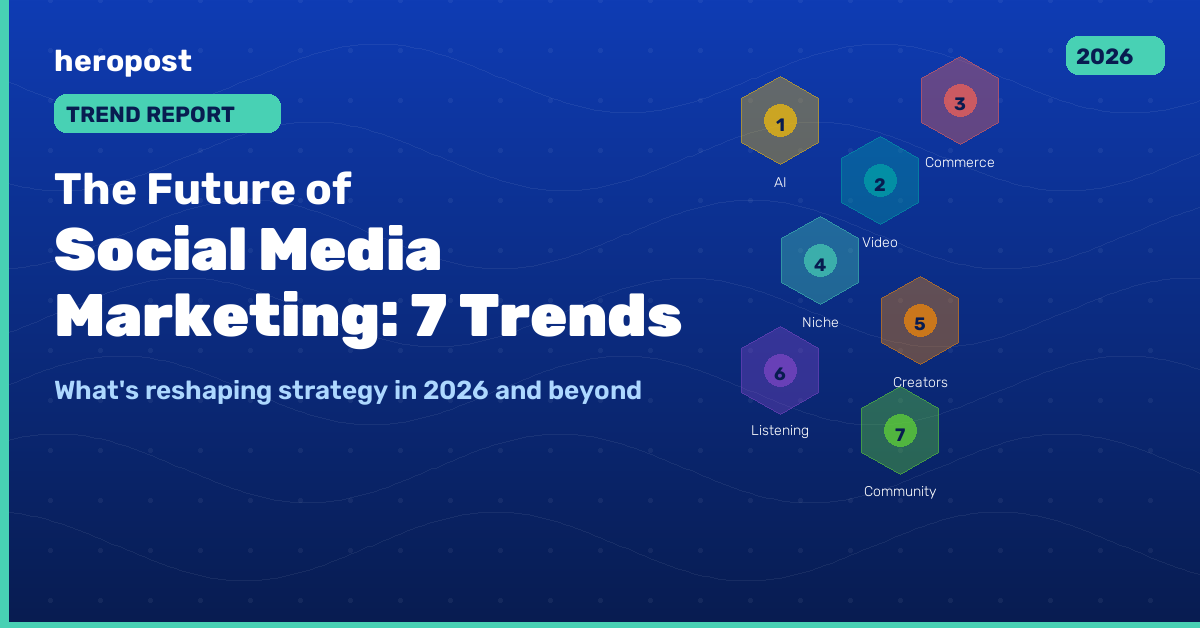
This is not about chasing every trend. It is about understanding which shifts are structural — the kind that will still matter in three years — and which are noise. Here are the seven trends that fall into the first category.
Trend 1: AI-Assisted Content at Scale Has Become the Standard, Not the Exception
In 2023, AI content tools were a competitive advantage. In 2026, they are table stakes.
The brands that are winning are not using AI to replace their content teams — they are using AI to extend them. The pattern looks like this: human strategists set the direction and define the brand voice, AI tools generate the first draft or the visual concepts, human editors refine and approve, and scheduling tools like Heropost deploy content at scale.
The result is that brands with a single content creator can now maintain a publishing cadence that would have required a team of five in 2022. This has democratised high-volume content production and simultaneously raised the baseline expectation for how consistently brands post.
What this means for your strategy: If you are not using AI tools in your content workflow, you are operating at a structural disadvantage to competitors who are. The question is not whether to use AI — it is how to use it without losing the brand authenticity that audiences respond to.
Trend 2: Short-Form Video Is the Default Format, But Retention Is the New Metric
Reels, TikToks, and Shorts have been growing for years. What has changed in 2026 is that the algorithm signals have matured: platforms are now heavily rewarding average view duration and completion rate over raw view counts.
This means that getting a video seen is no longer the goal. Getting it watched to the end is.
The content formats that perform best under this dynamic:
– Pattern interrupts in the first two seconds: The hook that stops the scroll now needs to be visual, not just textual
– Educational content with clear value payoffs: “Watch to the end to see the full result” works when the payoff is genuine
– Serialised content: Multi-part series drive completion because viewers who invest in episode one want to see episode two
What this means for your strategy: Audit your short-form video performance using watch time data, not just view counts. Reformat your best-performing text content into short-form video with visual hooks.
Trend 3: Social Commerce Is Becoming the Primary Discovery Channel for Younger Audiences
For audiences under 35, social media has largely replaced search engines as the first step in product discovery. TikTok Shop, Instagram Shopping, and Pinterest’s shopping integrations have created seamless paths from content to purchase without leaving the app.
The data is striking: a 2025 Global Commerce Report found that 61 percent of Gen Z consumers discovered their last purchase through social media content, compared to 29 percent through a search engine.
This trend has significant implications beyond e-commerce. B2B brands, SaaS companies, and service businesses are discovering that social-first discovery matters even when the eventual conversion happens off-platform.
What this means for your strategy: Build your social content to serve the discovery phase of the buyer journey, not just brand awareness or engagement. Educational content that answers the questions buyers ask before they know they need you is disproportionately valuable.
Trend 4: Platform Fragmentation Is Accelerating — Niche Wins
The era of two or three platforms dominating everyone’s attention is over. In 2026, audiences are distributed across a much wider range of platforms: Reddit, Substack, Discord, BeReal, Lemon8, and emerging regional social networks that have significant user bases in specific geographies.
For most brands, this does not mean you need to be everywhere. It means you need to know where your specific audience is spending time, and build a genuine presence on the two or three platforms that matter most for your segment.
The mistake many brands make is trying to maintain a presence across twelve platforms with thin, undifferentiated content. The brands that are winning in the fragmented landscape are the ones that show up with platform-native content: they speak TikTok’s language on TikTok, LinkedIn’s language on LinkedIn, and do not try to post the same caption everywhere.
What this means for your strategy: Audit where your highest-value audience segment actually spends time. Concentrate effort on two or three platforms where your content can genuinely resonate, then use cross-posting tools (like Heropost) for secondary platform presence without extra production effort.
Trend 5: Creator Partnerships Are Replacing Traditional Advertising for Discovery
Influencer marketing has matured into creator partnerships, and the distinction matters. Influencer marketing was largely transactional: pay someone with a large following to mention your product. Creator partnerships are strategic: work with creators whose content style, values, and audience genuinely align with your brand.
The shift has happened because audiences have become significantly more sophisticated at identifying paid promotion, and because authenticity (or the perception of it) has become the primary trust signal in social media content.
What is working in 2026:
– Long-form creator partnerships with 3–6 month exclusive arrangements rather than one-off posts
– Nano and micro-creator programmes that partner with 50–200 smaller creators rather than one celebrity
– Co-creation models where creators have genuine input into the product or campaign, not just access to a brief
– Employee advocacy programmes where team members create authentic behind-the-scenes content
What this means for your strategy: If paid social ads are your primary acquisition channel, evaluate whether a creator programme could reach the same audience with higher trust. For brands with tight budgets, micro-creator outreach can deliver better cost-per-acquisition than traditional display or social advertising.
Trend 6: Social Listening Has Become a Core Strategic Input, Not a Monitoring Task
Social listening used to mean tracking brand mentions and flagging negative comments for the customer service team. In 2026, the most sophisticated brands use social listening as a primary strategic input for product development, content planning, and competitive intelligence.
The tools for this have matured significantly. AI-powered sentiment analysis, theme clustering, and trend detection now make it possible to extract structured insights from unstructured social data at a scale that was not practical three years ago.
What leading brands are doing with social listening data:
– Informing product roadmaps with real-time feature demand signals from social conversations
– Identifying emerging audience language to use in ad copy and content before competitors do
– Tracking competitor sentiment to identify gaps and weaknesses in their positioning
– Building community intelligence that informs quarterly content strategy decisions
For a tool like Heropost, the roadmap conversations happening on the Trello board and in community forums are a direct example of social listening driving product direction — the four features in active development are the top four user requests, surfaced through exactly this kind of listening.
What this means for your strategy: If social listening is currently a reactive function (monitoring for crises and mentions), consider elevating it to a proactive research function. Even basic sentiment analysis on your top competitor’s content can reveal positioning opportunities.
Trend 7: Community-First Content Strategy Is Outperforming Broadcast Content
The brands that are building the most durable social media presence in 2026 are the ones that think of their social channels as communities to serve, not audiences to broadcast to.
This shift shows up in measurable ways: posts that invite conversation, acknowledge community members by name, respond to comments with genuine engagement, and share user-generated content consistently outperform broadcast-style content in organic reach across every major platform.
The algorithms across Instagram, TikTok, LinkedIn, and Facebook have all shifted to prioritise “meaningful interactions” — comments, shares, saves, and DM activity — over passive metrics like likes. Content designed to generate conversation ranks higher than content designed to generate passive approval.
What this means for your strategy: Review your recent content calendar through a community lens. What percentage of your posts invite dialogue versus broadcast information? What is your average comment-to-like ratio? Teams that shift even 20–30 percent of their content from broadcast to community-focused formats typically see meaningful engagement rate improvements within 60 days.
How to Apply These Trends Without Overhauling Your Entire Strategy
The right response to these trends is not to rebuild your content strategy from scratch. It is to make targeted adjustments in the areas with the highest leverage.
A practical prioritisation framework:
| Trend | Effort to Implement | Potential Impact | Priority |
|---|---|---|---|
| AI workflow tools | Low — tool integration | High — volume and efficiency | Start now |
| Short-form video hooks | Medium — format shift | High — algorithmic reach | Start now |
| Social commerce integration | Medium — platform setup | High for e-commerce | High |
| Platform focus (2–3 primary) | Low — strategic decision | High — depth over breadth | High |
| Creator partnerships | High — relationship building | High — trust and discovery | Medium |
| Social listening strategy | Medium — tooling and process | Medium — insight quality | Medium |
| Community content shift | Low — editorial direction | High — organic reach | Start now |
Conclusion
The social media marketing landscape of 2026 rewards brands that combine the efficiency of AI-assisted production with the authenticity of genuine community engagement. The tools have never been better for scaling content production. The challenge is ensuring that scale does not come at the expense of the human voice that makes social media worth following.
The brands that will look back on 2026 as the year they pulled ahead are the ones that pick the right platforms, build real workflows for consistent publishing, invest in creator relationships, and never lose sight of the community behind the metrics.
Your strategy for the rest of 2026 does not need to be complicated. It needs to be consistent, platform-native, and genuinely useful to the people you are trying to reach.