B2B social media marketing has a reputation problem. Too many companies treat it as an afterthought — posting bland corporate updates and product announcements that generate zero engagement, then concluding that “social media doesn’t work for B2B.”
The reality is different. B2B companies with genuine social media strategies are generating significant pipeline from LinkedIn, YouTube, and even TikTok. The difference is not budget or follower count — it is approach.
B2B social media works when you stop thinking about it as a broadcasting channel and start treating it as a relationship-building and trust-establishment platform. This guide covers exactly how to do that.
Why B2B Social Media Matters More Than Ever
Three shifts have made social media critical for B2B companies in 2026:
The buyer journey has moved online. B2B buyers conduct extensive independent research before engaging with sales. Gartner research shows that B2B buyers spend only 17% of their purchase journey talking to suppliers — and split that time across multiple vendors. The other 83% is spent researching online, including social media.
Dark social is growing. Much of the influence social media has on B2B buying decisions is invisible to attribution tools. A prospect reads a LinkedIn post from your CEO, shares it with a colleague, and that colleague raises your company in a procurement meeting six months later. The CRM records it as “direct” but social media drove it.
Younger buyers are now decision-makers. Millennials make up the majority of B2B buyers and 73% of them are involved in purchase decisions. This is the generation that grew up with social media. They research vendors on LinkedIn, watch YouTube demos, and check company credibility on social before taking a sales call.
The Right Platforms for B2B Social Media
LinkedIn — The Non-Negotiable Core
LinkedIn is the primary B2B social platform, full stop. It is where your prospects are actively thinking about work problems. The content performs well. The targeting for paid amplification is unmatched. Every B2B company needs a LinkedIn strategy.
What works on LinkedIn:
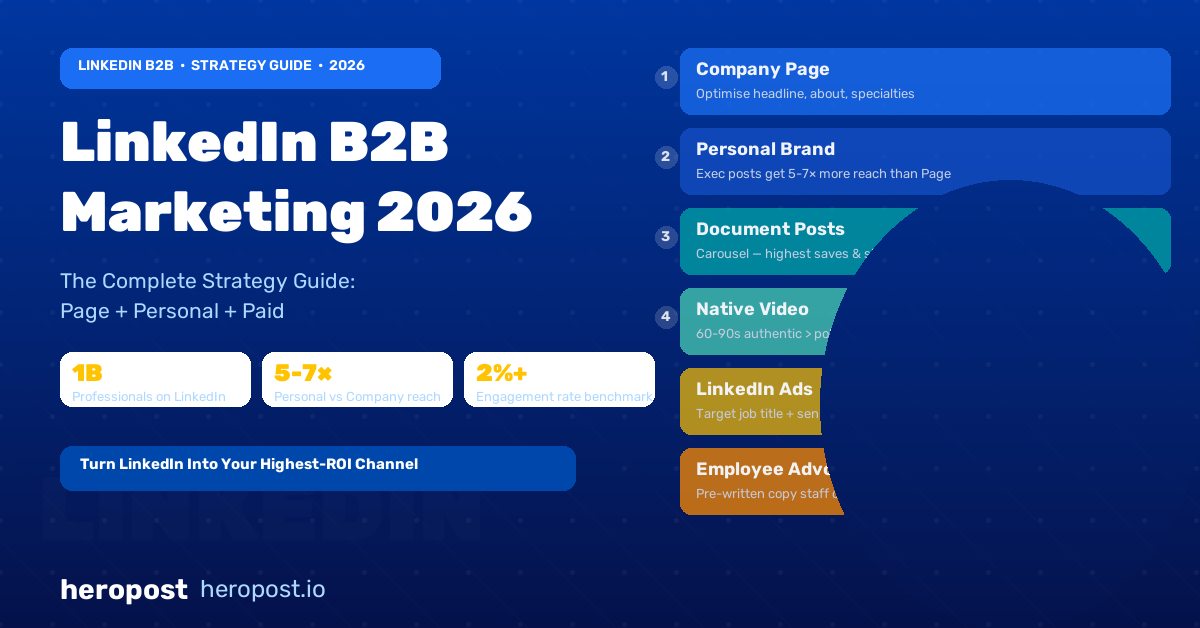
- Thought leadership from individuals: The most effective B2B LinkedIn content comes from people, not company pages. Encourage founders, executives, and subject matter experts to post. Personal profiles consistently outperform company pages in organic reach.
- Educational content: How-to posts, frameworks, industry analysis, and counter-intuitive takes perform exceptionally well. The best-performing LinkedIn posts teach something useful in 3 minutes or less.
- Data and research: Original data — surveys, proprietary benchmarks, analysis of your customer base — performs very strongly. B2B audiences share content that makes them look informed.
- Case studies and social proof: Results-focused posts (“How [Company] achieved X using Y”) drive high engagement from prospects at the consideration stage.
- Video: LinkedIn video is increasingly rewarded by the algorithm. Short explainers (60-90 seconds), interview clips, and product demos perform well.
YouTube — The Long Game for B2B
YouTube is underused by most B2B companies and over-used by the ones who figure it out. Educational video content — how to solve problems your prospects face — builds trust at scale and has compounding value over time.
B2B YouTube content that works:
- Product tutorials and use case demonstrations
- Industry explainer videos (how does [technical concept] work?)
- Webinar recordings and conference talks
- Expert interview series
- “How we” case study videos with customers
YouTube videos rank in Google Search, appear in LinkedIn feeds when shared, and can be repurposed across every other platform. A single well-produced video generates value for years.
X (Twitter/X) — For Specific Industries
X remains relevant for specific B2B verticals: tech, finance, media, legal, and policy. If your buyers are active on X, your presence there matters. If they are not, prioritise elsewhere.
TikTok — The Emerging B2B Channel
TikTok for B2B sounds counterintuitive but works for companies whose buyers are younger professionals or where educational content can be made entertaining. B2B TikTok accounts in accounting, HR tech, legal, and marketing SaaS have built significant engaged audiences.
B2B Content Strategy: What to Post
Content Pillar 1: Industry Expertise
Position your company (and its people) as the most knowledgeable voice in your space.
- Analysis of industry trends and what they mean for your audience
- Takes on news and developments in your sector
- Research and data posts drawing on your proprietary insights
- “What we’re seeing” posts that share genuine observations from your customer base
The goal is to make your target audience feel that following you makes them better at their job.
Content Pillar 2: Educational How-To Content
Solve the problems your prospects are trying to solve — even if your product is not directly involved.
- Process guides: “How to run an effective [process your buyers manage]”
- Framework posts: “The 5-step approach we recommend for [challenge]”
- Template shares: “The spreadsheet/template our customers use for [task]”
- Myth-busting: “3 things people get wrong about [your space]”
Content Pillar 3: Social Proof and Results
Demonstrate that your solution works with specific, credible evidence.
- Customer case studies with specific metrics (revenue increased by X%, time saved per week: Y hours)
- Customer quotes and testimonials (video performs best)
- Before/after narratives: what the situation was before, what changed, what the outcome was
- Product milestone announcements framed around customer value
Content Pillar 4: Company and People
B2B buyers buy from people they trust. Show who is behind the company.
- Team expertise posts: who are your people, what do they know?
- Hiring announcements (signals growth and credibility)
- Behind-the-scenes of how you build or deliver
- Company values in action — not stated values, but actual examples
LinkedIn-Specific Tactics That Drive Results
Optimise personal profiles before the company page. Your executives’ LinkedIn profiles are often the first thing a prospect looks at when evaluating your company. Ensure they are complete, professional, and position the individual as an expert rather than just a job title.
Post from individuals, amplify from the company page. Write a strong post on a personal profile. The company page then shares it. This structure consistently outperforms company-first posting in organic reach.
Use the creator mode. Accounts with creator mode enabled get access to newsletter features, topic follow buttons, and increased algorithmic reach for long-form posts.
Engage before you post. Spend 15 minutes commenting genuinely on relevant posts in your industry before posting your own content. This warms the algorithm and builds relationships with potential amplifiers.
LinkedIn newsletters. B2B companies with consistent LinkedIn newsletters build a recurring readership that receives notifications when new editions publish. Lower friction than email newsletters, growing faster, and currently rewarded by LinkedIn with increased distribution.
Employee advocacy. When your team shares and comments on company content, LinkedIn distributes it far more widely. Even 5–10 employees engaging within the first hour of a post significantly increases its reach. Use a simple Slack reminder workflow or a tool like Heropost to coordinate this.
B2B Content Calendar Structure
A workable B2B posting schedule by platform:
| Platform | Frequency | Content Type |
|---|---|---|
| LinkedIn (Company) | 3-4x/week | Industry insights, case studies, product updates |
| LinkedIn (Executives) | 3-5x/week per person | Thought leadership, personal perspectives |
| YouTube | 1-2x/week | Educational videos, product demos, webinars |
| X | 3-5x/week | Real-time commentary, quick insights, engagement |
| TikTok (if relevant) | 2-3x/week | Educational short-form video |
Measuring B2B Social Media ROI
B2B social media ROI is harder to measure than B2C but not impossible. Use a layered approach:
Vanity metrics (directional only): Follower growth, impressions, engagement rate. These signal whether content is resonating, but do not directly connect to revenue.
Traffic metrics: Social referral traffic to website, demo page, and pricing page. Use UTM parameters on all links. This shows intent signals from your social audience.
Pipeline influence: Ask every inbound lead “how did you first hear about us?” and “what convinced you to reach out?” Include social media as a specific option. Track this in your CRM.
Content attribution: Tag every piece of sales collateral with the content that preceded the deal. Sales reps often know which LinkedIn posts a prospect mentioned on a call — capture this data.
The 6-month rule: B2B social media builds trust over time. Judge the ROI over a 6-month window minimum. Companies that give up after 6 weeks are measuring the wrong thing.
Common B2B Social Media Mistakes
Only posting about your product. Nobody follows a brand whose entire feed is product advertising. Your ratio should be roughly 70% educational/industry content, 20% company/culture, 10% direct promotion.
Waiting for perfection. B2B marketers frequently over-produce content that ends up looking polished but feeling inauthentic. A straightforward LinkedIn post with genuine insight outperforms a beautifully designed graphic with a generic message every time.
Ignoring comments and DMs. B2B social media is a conversation. When a prospect comments on your post, respond quickly and genuinely. This is how relationships start.
No executive voice. Company pages have limited reach. The biggest ROI in B2B social media comes from activating the personal brands of your leadership team.
Inconsistency. Three months of daily posting followed by two months of nothing is worse than three posts per week consistently. Consistency is the most important variable.
Conclusion
B2B social media marketing in 2026 rewards the companies that play the long game — building trust, sharing genuine expertise, and showing up consistently over months and years rather than looking for immediate ROI.
The foundation is simple: be genuinely useful to your target audience on the platforms where they spend time. Everything else follows from that.
Heropost helps B2B teams manage their social media consistently — schedule posts across LinkedIn, YouTube, and all other platforms, manage team workflows and approvals, and track what content drives the most engagement. Start your free trial at heropost.io.