Introduction
Social media evolves faster than any other marketing channel. Algorithm changes, new features, platform pivots, and shifts in audience behaviour happen on timescales of months — and marketers who miss the signals spend their budgets optimising for conditions that no longer exist.
Q2 2026 is bringing several significant shifts that will reshape how effective social media marketing works for the rest of the year. Some are continuations of trends that have been building for months. Others are new developments that are changing the rules faster than most teams have adapted.
Here is what matters most right now.
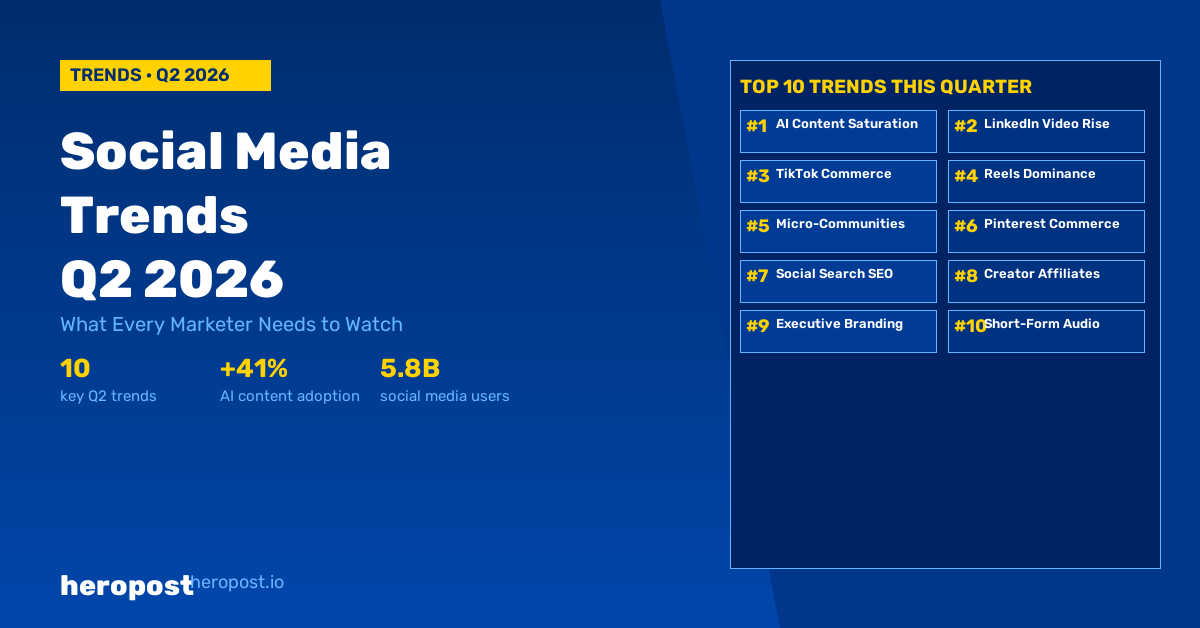
Trend 1: AI-Generated Content Saturation — and the Premium on Authenticity
The democratisation of AI content tools over the past two years has flooded social media with volume. Every platform is now contending with a significant increase in content that is technically competent but emotionally empty — AI-written captions, AI-generated images, AI-assembled videos that look professional but feel hollow.
The consequence is predictable: human authenticity has become a scarcity premium. Content that is visibly, undeniably human — rough around the edges, genuinely personal, specific in its observations — is outperforming polished AI-generated content in engagement metrics across Instagram, TikTok, and LinkedIn.
What this means for marketers:
Stop trying to make your content look more produced. Lean into specificity, personality, and genuine perspective. The authenticity signals that once felt like weaknesses (unscripted moments, personality-forward content, specific rather than generic observations) are now competitive advantages.
AI tools remain valuable for research, outlining, and accelerating production — but the content that performs best is still the content that sounds like a real person with a real opinion.
Trend 2: LinkedIn’s Continued Dominance for B2B
LinkedIn’s position in the B2B marketing landscape has continued to strengthen through Q1 2026. Organic reach on LinkedIn remains higher than on Facebook or Instagram for the same audience size — making it one of the last platforms where unpaid content can still achieve meaningful business results.
Three specific LinkedIn developments are reshaping B2B social media:
Video’s continued rise: LinkedIn video, both short-form (under 90 seconds) and long-form (3-10 minutes), is seeing significantly higher reach than text posts for most account types. Teams and individuals not yet creating video for LinkedIn are leaving reach on the table.
Newsletter subscriber monetisation: LinkedIn newsletters with large subscriber bases are generating direct commercial value through sponsored editions, course promotions, and consulting pipeline. This is now a legitimate B2B marketing asset.
Executive thought leadership as primary strategy: The companies seeing the most LinkedIn growth are those investing in the personal profiles of their C-suite and senior team members, not just their company pages. Individual accounts consistently outperform company accounts in organic reach.
What this means for marketers:
If you have not activated LinkedIn video and if your executives are not posting, these are the two highest-leverage LinkedIn investments available in Q2 2026.
Trend 3: TikTok Commerce Growing Significantly
TikTok Shop’s growth has continued to exceed analyst expectations through early 2026. In-app purchase behaviour — discovering a product in a TikTok video and buying it without leaving the app — is becoming normalised for consumers under 35.
For e-commerce brands, the implication is significant: TikTok is no longer just a brand awareness channel. It is a transaction channel. Brands without a TikTok Shop presence are missing a growing revenue stream.
The creator affiliate model has also matured. TikTok’s affiliate programme — where creators earn commission on sales they drive through unique links — has produced significant results for brands that have built creator relationships with the right niche audiences.
What this means for marketers:
If you sell physical products and are not on TikTok Shop, Q2 2026 is the right time to start. The early-mover advantage in TikTok commerce diminishes as more brands enter the space.
Trend 4: Instagram Reels Remaining the Top Organic Reach Format
Despite the maturation of the Reels format (Instagram launched Reels in 2020), it remains the top organic reach format on the platform in 2026. Accounts that consistently produce Reels continue to outperform accounts that rely primarily on static posts for organic discovery.
Two Reels-specific patterns are particularly notable in Q2:
Longer Reels performing better: Instagram’s algorithm appears to be rewarding Reels in the 60-90 second range more than the 15-30 second clips that dominated in earlier years. This aligns with TikTok’s own shift toward longer video.
Educational Reels with text overlays: “How to” and “did you know” content with on-screen text is being saved and shared at higher rates than entertainment-first content. The save signal is particularly important for Reels — accounts with high save rates see the strongest reach expansion.
What this means for marketers:
Invest in Reels production. Aim for 60-90 seconds. Include text overlays for viewers watching on mute. Optimise for saves (ask yourself: would someone save this to refer back to?).
Trend 5: The Rise of Micro-Communities
Across all major platforms, audience behaviour is shifting from passive consumption of broadcast content to active participation in micro-communities. Facebook Groups, Discord servers, LinkedIn communities, Substack comment threads — the audiences building the deepest loyalty are not the ones with the most followers. They are the ones with the most engaged communities.
This shift has practical implications for content strategy. Broadcast content (posting and waiting for reactions) is becoming less effective. Community content (asking questions, facilitating discussions, featuring community members) is becoming more effective.
What this means for marketers:
Invest in community infrastructure. Start a Facebook Group, a Discord server, or a LinkedIn community. Shift at least 20% of your social media effort from broadcasting to facilitating conversations. The depth of engagement in a 500-person active community often exceeds the value of 50,000 passive followers.
Trend 6: Pinterest’s Quiet Commerce Renaissance
Pinterest has had a quieter rise than other platforms but its commercial performance has been consistently strong through Q1 2026. Key factors: shoppable pins have been refined, the platform’s search behaviour (users actively looking for specific aesthetics and products) produces high purchase intent, and Pinterest’s user base has grown significantly in the 25-44 female demographic — one of the highest-spending demographics in consumer markets.
For brands in home décor, fashion, food, wedding, and gifting categories, Pinterest deserves significantly more attention than most marketing teams give it.
What this means for marketers:
If your target demographic includes women aged 25-44 and your product is in a visual category, run a Pinterest experiment in Q2 2026. Set up Product Rich Pins, post consistently for 90 days, and measure referral traffic quality.
Trend 7: Social Search is Overtaking Traditional Search for Younger Users
Research consistently shows that users under 30 are increasingly using TikTok, Instagram, and YouTube as their primary search engines — not Google. This has significant SEO implications: content that ranks well on social platforms reaches younger audiences who never make it to Google.
Practical consequence: the keywords that matter for your audience are increasingly the ones that work in TikTok captions and Instagram descriptions, not just in website meta tags.
What this means for marketers:
Integrate keyword research into your social media content strategy. Identify the search terms your target audience uses on TikTok and Instagram (use the platform’s own search function to see auto-suggest results). Create content around those terms. This is a form of social SEO — and it is becoming as important as traditional search optimisation for audiences under 35.
What to Prioritise in Q2 2026
Given these trends, the highest-leverage moves for most marketing teams this quarter:
- Activate LinkedIn video if you are not already producing it
- Test TikTok Shop if you sell physical products
- Invest in Reels — 60-90 seconds, text overlays, optimised for saves
- Start or revitalise a community — Facebook Group, Discord, or LinkedIn community
- Lean into human authenticity — specific, personal, unpolished content that AI cannot fake
The brands that adapt to these shifts in Q2 will be better positioned for the second half of 2026 than those that continue executing last year’s playbook.
Heropost helps you stay ahead of platform changes — schedule content across all channels, track what is working, and adapt your strategy quickly when the platforms shift. Start your free trial at heropost.io.