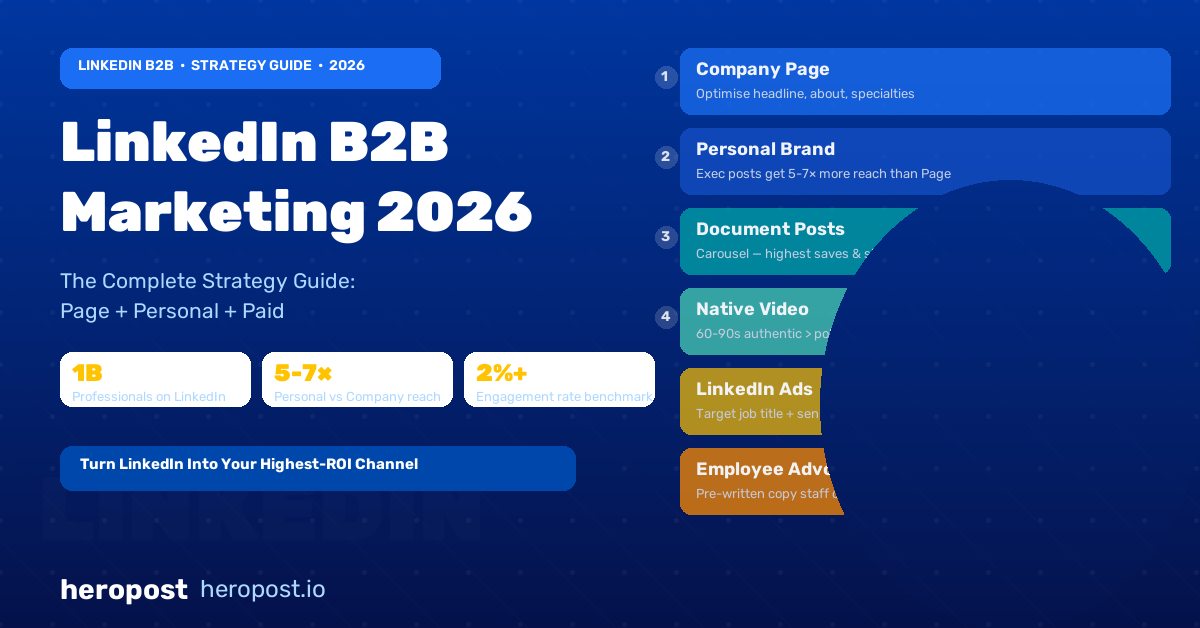
LinkedIn is not just a social network for job seekers. In 2026, it is the most powerful business development tool available to professional services firms, B2B companies, and anyone whose clients are other businesses or working professionals.
Used correctly, LinkedIn builds the kind of warm pipeline that results in inbound enquiries, referral introductions, and renewed relationships with dormant contacts — without cold calling, email spam, or advertising spend.
Used incorrectly — or not at all — LinkedIn is a missed opportunity that becomes increasingly costly as competitors who understand it build advantages that compound over years.
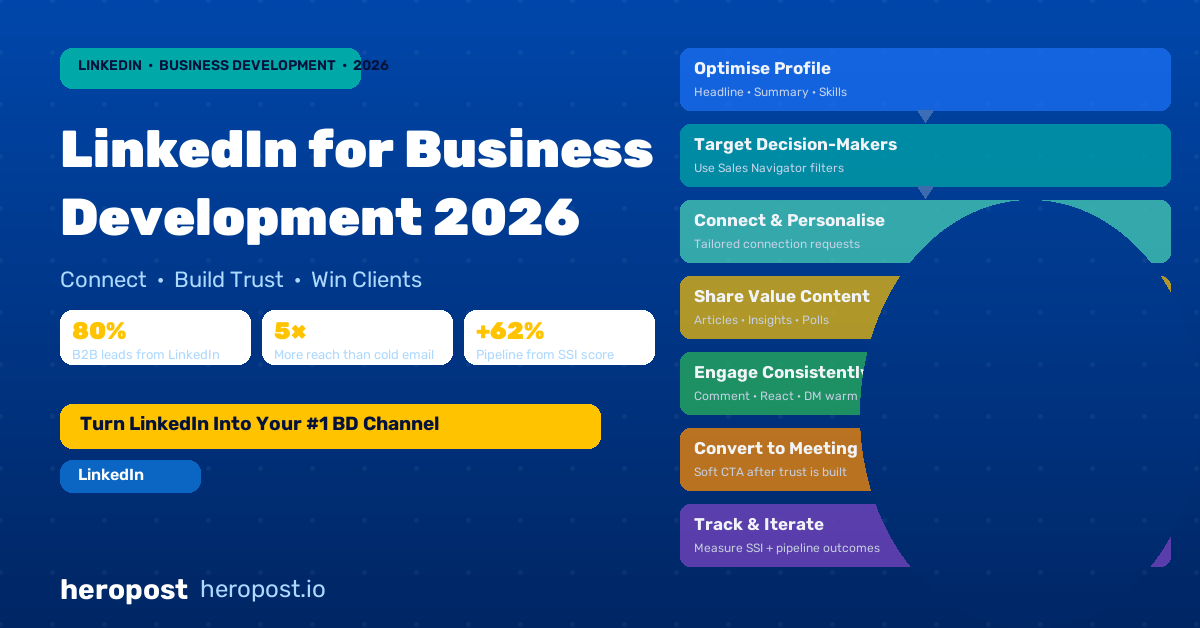
This guide covers the complete LinkedIn business development system: profile optimisation, content strategy, relationship building, and direct outreach — the four pillars that together create a sustainable business development engine.
Pillar 1: Profile Optimisation
Your LinkedIn profile is the first thing a prospective client, referral source, or potential partner looks at. Before any content or outreach strategy, your profile needs to do its job.
The Headline is Prime Real Estate
Most professionals waste their headline on their job title. “Partner, Smith & Partners LLP” tells a prospect nothing about why they should care about you.
A strong LinkedIn headline communicates your value proposition in 120 characters: who you help, with what, to what outcome.
Examples:
– “Helping UK tech startups navigate R&D tax credits and funding rounds | Chartered Accountant”
– “Commercial litigation solicitor | Helping SMEs resolve disputes without losing a year of productivity”
– “Financial adviser | Helping professionals build retirement plans that work without obsessing over the market”
The headline appears in search results, connection requests, and comment sections — everywhere your name appears on LinkedIn. Optimise it.
The About Section Tells Your Story
Write in first person. Lead with the problem you solve, not your biography. The first 2-3 lines appear before the “see more” fold — make them compelling enough to earn the click.
Structure:
1. The problem or situation your ideal client faces
2. How you address it and what that achieves
3. Brief background on your credibility and approach
4. Clear call to action: what should someone do if they want to work with you or learn more?
Featured Section: Showcase Your Best Work
Use the Featured section to highlight your most persuasive content: a case study, a YouTube video, a published article, a downloadable guide. This is prime portfolio real estate that most profiles leave blank.
Complete Your Profile Fully
LinkedIn’s algorithm significantly increases distribution of content from profiles with 100% completeness. This means: profile photo, banner image, all experience sections completed, skills listed, education filled in, and at least three recommendations from credible connections.
Pillar 2: Content Strategy
LinkedIn content is the most efficient business development lever most professionals have — because it builds awareness and credibility at scale with no marginal cost per impression.
What to Post
The content that performs best for business development on LinkedIn in 2026:
Personal perspective posts: Your observations, opinions, and takes on your industry. “Here is something I have noticed about [trend] that most people are not talking about.” These posts generate engagement because they invite response — agreement, disagreement, or additional perspective.
Specific expertise posts: Deep dives into aspects of your field that demonstrate genuine mastery. A conveyancing solicitor explaining the nuances of leasehold reform. A marketing strategist breaking down what actually drives B2B pipeline. Specific, expert-level content that only someone who truly knows their field could write.
Client situation stories: “A client came to me last week with [situation]. Here is how we thought through it.” Anonymised, specific, story-driven content that demonstrates how you think and what it is like to work with you.
Counter-intuitive takes: “The conventional wisdom about [topic] is wrong. Here is what I have seen actually work.” These posts generate significant engagement because they disrupt assumptions — and the people who engage are often exactly the prospects you want.
Practical guides and frameworks: Structured educational content that delivers real value in a LinkedIn-native format. Lists, frameworks, step-by-step guides.
How Often to Post
Three to five times per week is optimal for most LinkedIn business development strategies. Fewer than three posts per week produces slow results; more than five starts to feel like noise to your network.
Consistency matters more than frequency. Three posts per week, every week, for a year outperforms five posts per week for a month followed by silence.
When to Post
For B2B audiences, Tuesday through Thursday between 8-10am and 12-1pm in your audience’s timezone consistently performs well. Monday mornings are strong for thought-leadership content. Friday afternoons are significantly weaker.
Use your own analytics to refine this — after 60-90 days of consistent posting, LinkedIn will show you exactly when your specific audience is most active.
Pillar 3: Relationship Building
Content builds awareness. Relationship building is how that awareness converts to business development outcomes.
Engage Meaningfully With Your Target Contacts
Follow the LinkedIn profiles of prospective clients, referral sources, and people in your professional ecosystem. When they post, comment genuinely — not just “great post!” but a substantive response that adds to the conversation or demonstrates that you have read and thought about what they wrote.
This is not a fast tactic. Done consistently over weeks and months, it builds a genuine professional familiarity with people who may never have taken a meeting with you through cold outreach.
Connect Strategically, Not Indiscriminately
LinkedIn connection requests sent with personalised messages convert at dramatically higher rates than blank connection requests — and create a better quality of connection.
When connecting with someone you want in your professional network: reference something specific about their work or a recent post they wrote, explain briefly why you are connecting, and make it clear that you are not immediately asking for anything.
Reconnect With Dormant Relationships
Your existing LinkedIn connections include former colleagues, past clients, conference contacts, and people you have not spoken to in years. A proportion of these are potential clients, referral sources, or advocates — but the relationship has gone cold.
Reconnecting does not require a reason or an ask. Comment on something they posted. Share content they might find valuable with a personal note. These warm touchpoints reactivate relationships far more effectively than cold outreach to new contacts.
The LinkedIn DM: When and How
Direct outreach via LinkedIn DM works when it is warm, specific, and value-focused. It fails when it is a generic sales pitch.
When to DM:
– After several genuine interactions (comments, shares) with someone who fits your ideal client profile
– When you have a specific reason to connect: “I saw your post about [topic] and thought [specific response] — I have been working on something related and would value your perspective”
– To offer something of genuine value: sharing a resource, making an introduction, flagging something relevant to their situation
When not to DM:
– Immediately after connecting (the “thanks for connecting, by the way here is my service pitch” is the most-blocked message on LinkedIn)
– With a generic template that is clearly not personalised
– To ask for a meeting before any relationship has been established
Pillar 4: LinkedIn-Specific Business Development Tactics
LinkedIn Newsletter
Starting a LinkedIn newsletter builds a subscriber list within LinkedIn and notifies subscribers every time you publish. For business development, a consistent newsletter on a topic relevant to your clients establishes you as a must-read authority — and subscribers are self-selected as people interested in your area of expertise.
LinkedIn Live and Events
Hosting LinkedIn Live sessions — webinars, Q&As, expert panels — generates significant reach and positions you as a convener in your professional community. Attendees are warm prospects; the recording extends the reach beyond the live audience.
LinkedIn Articles
Long-form articles (1,500+ words) published on LinkedIn rank in Google search and LinkedIn’s own search function. For evergreen topics relevant to your target clients, LinkedIn articles can generate enquiries for years after publication.
Social Selling Index (SSI)
LinkedIn measures your effectiveness across four dimensions: establishing your professional brand, finding the right people, engaging with insights, and building relationships. A higher SSI score correlates with better content distribution.
Measuring LinkedIn Business Development Results
Metrics that matter:
Content performance: Impressions, engagement rate, profile views after specific posts (a high-performing post typically drives a spike in profile views — these are warm prospects evaluating your credentials)
Connection quality: Are you connecting with your target audience? Review new connections monthly.
Direct outcomes: Track DM conversations that led to meetings, referrals mentioned via LinkedIn, and clients who say “I found you on LinkedIn” in onboarding conversations. Ask every new client directly.
Pipeline influence: Note which live deals involved LinkedIn touchpoints. Many professionals find LinkedIn influenced the relationship without being the direct source of the enquiry.
Conclusion
LinkedIn business development is a long game that rewards consistency and genuine expertise. The professionals who show up every week with valuable content, engage authentically with their network, and connect with intention build business development machines that produce results long after the initial investment is forgotten.
The best time to start was two years ago. The second-best time is now.
Heropost makes LinkedIn management efficient — schedule your posts, manage your content calendar, and track performance across all platforms from a single dashboard. Start your free trial at heropost.io.