Introduction
Your competitors are running experiments with their own budgets and reporting the results publicly — on their social media profiles, for anyone to see. Social media competitor analysis is the practice of systematically learning from those results: what content is working for them, what audience they are attracting, what gaps they are leaving that you can fill.
Done correctly, competitor analysis informs content strategy, platform prioritisation, audience positioning, and messaging — making it one of the highest-leverage research activities available to a marketing team. Done incorrectly — copying competitor content, chasing their metrics without understanding the strategy behind them — it produces mediocre imitation rather than competitive advantage.
This guide walks through the complete competitor analysis process for social media in 2026.
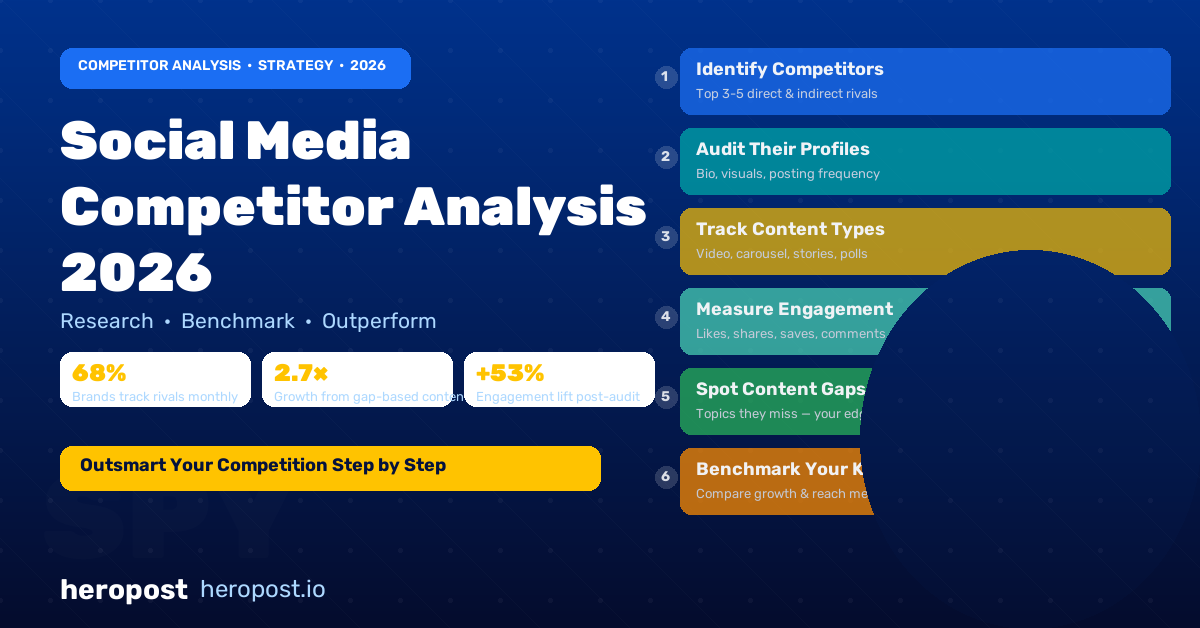
Step 1: Define Your Competitor Set
Not every company in your industry is a social media competitor. Define your set with precision.
Direct competitors: Companies offering the same product or service to the same audience. These are your primary benchmark set.
Indirect competitors: Companies solving the same customer problem differently, or serving an adjacent audience. These often provide more creative inspiration than direct competitors because they are not constrained by the same category conventions.
Aspirational competitors: Companies or creators at a significantly higher level of social media execution than you. These set the standard you are building toward.
Audience competitors: Creators, publishers, or brands that compete for your audience’s attention even if they do not compete for their business. Understanding what holds your audience’s attention outside your category is valuable context.
Aim for a primary set of 5-8 direct competitors to monitor regularly, supplemented by periodic analysis of indirect and aspirational examples.
Step 2: Audit Their Platforms
For each competitor, identify:
- Which platforms they are active on (presence vs. active posting)
- Their follower/subscriber count on each platform
- Their posting frequency
- Their primary content formats (video, text, image, carousel)
- Their engagement rates (this is the signal that matters most, not follower count)
How to calculate engagement rate: (Total engagements on a post ÷ followers) × 100. For a benchmark: above 1% on Instagram is decent; above 3% is strong. On LinkedIn, above 2% is strong. TikTok benchmarks are higher (3-8%+).
Track this in a simple spreadsheet. You are looking for patterns, not point-in-time numbers — what platforms are they investing in most, and what formats are generating disproportionate engagement relative to their following?
Step 3: Analyse Their Content Strategy
Go deeper than surface metrics. Study the actual content:
What topics do they cover? Map their content across a 30-60 day window. What themes dominate? What is conspicuously absent?
What is their content tone? Educational, entertaining, promotional, thought leadership, community-first? Tone is often as differentiating as topic.
What is their hook strategy? Look at their top-performing posts specifically. What kind of headline, opening line, or opening frame do their best posts share?
What is their CTA pattern? Are they driving to website, to DMs, to a lead magnet, or primarily building engagement within the platform?
What content gets their best engagement? Sort their posts by engagement rate, not chronologically. The content that performs best for them reveals what their shared audience responds to — valuable signal even if you are going to approach it differently.
Step 4: Identify Gaps and Opportunities
Competitive analysis is most valuable when it reveals not what your competitors are doing, but what they are not doing.
Topic gaps: What questions is your shared audience asking that no competitor is answering well? Search for the questions your audience has (Reddit, Quora, Google autocomplete, comments on competitor posts) and map them against what competitors are covering. The white space is your opportunity.
Format gaps: If all competitors rely heavily on text posts and infographics, video is a differentiator. If everyone is on LinkedIn but nobody is building on YouTube, YouTube is an opportunity. Look for formats your competitors are underinvesting in.
Tone gaps: If all competitors communicate in a corporate, formal register, authentic and conversational content stands out. If the category defaults to casual and breezy, depth and rigour differentiate.
Audience gaps: Are competitors all targeting the same persona? Is there a segment of the audience that is underserved — smaller businesses, a specific profession, a geographic market, a particular level of sophistication?
Step 5: Benchmark Your Performance
Compare your metrics to your competitor set:
| Metric | You | Competitor A | Competitor B | Category average |
|---|---|---|---|---|
| Instagram followers | ||||
| Instagram engagement rate | ||||
| LinkedIn followers | ||||
| LinkedIn engagement rate | ||||
| Posting frequency (per week) | ||||
| Video % of content |
The goal is not to match your largest competitor on follower count — that comparison is rarely useful. The goal is to understand where you over- and underperform relative to your size, and to identify the strategic moves most likely to close the gaps that matter.
Tools for Social Media Competitor Analysis
Native platform analytics: Instagram, LinkedIn, and TikTok all provide some data on competitor performance if you follow their accounts. Limited but free.
Metricool: Excellent competitor tracking feature that monitors posting frequency, follower growth, and engagement metrics across multiple competitor profiles simultaneously.
SparkToro: Analyses where your audience (or a competitor’s audience) spends time online — invaluable for understanding channel strategy.
SEMrush / Ahrefs Social: Tracks competitor social content performance alongside SEO data — useful for understanding how social and search strategies connect.
Manual analysis: Do not underestimate this. Spending 30 minutes manually scrolling a competitor’s best-performing posts and taking notes on what you observe is often more insightful than any automated tool.
How Often to Do Competitor Analysis
Monthly: Quick scan of competitor posting patterns, follower growth, and any notable content that generated outsized engagement. 30-60 minutes.
Quarterly: Full audit — update your benchmark spreadsheet, review content strategy changes, identify new gaps and opportunities. 2-3 hours.
Ad hoc: When a competitor does something significantly different (new platform, new content format, new positioning, viral moment), study it promptly.
The biggest mistake is doing competitor analysis once and treating it as permanent. Social media strategies evolve constantly. What your competitor was doing six months ago is history; what they are doing now is intelligence.
What Not to Do With Competitor Analysis
Do not copy. Imitation is the enemy of differentiation. If a competitor has found a format or topic that works, understand why it works and find your own version — do not reproduce their content.
Do not optimise to beat their vanity metrics. Chasing follower count or likes as a primary goal produces the wrong content. Optimise for the business outcomes your social media exists to drive.
Do not ignore competitors entirely. The opposite mistake — “we do not look at what competitors do” as a point of pride — is equally counterproductive. Informed differentiation is better than uninformed differentiation.
Do not let analysis replace action. Competitor analysis is research in service of better decisions — not a substitute for creating and publishing content. Spend the minimum time needed to generate actionable insights, then act on them.
Conclusion
Systematic competitor analysis turns your competitors’ social media investments into shared intelligence. The companies and creators who monitor their competitive landscape regularly make better strategic decisions — choosing the right platforms, finding the underserved topics, and differentiating their positioning in ways that are informed rather than guessed.
Build the habit. Run the monthly scan. Do the quarterly deep dive. Apply what you learn.
Heropost’s analytics tools make competitor tracking easier — monitor your performance across all platforms and benchmark your results from a single dashboard. Start your free trial at heropost.io.