Introduction
LinkedIn’s dominance in B2B marketing is not accidental. The platform hosts 1 billion professionals — including the decision-makers, budget holders, and influencers at virtually every company your B2B brand wants to reach. While other platforms have wider reach, LinkedIn offers something more valuable for B2B: intentional professional context.
When someone opens LinkedIn, they are in a professional mindset. They are thinking about their work, their challenges, and their professional development. A piece of content that speaks to those challenges reaches them at exactly the right moment.
This guide covers how to build a LinkedIn B2B marketing strategy that drives real pipeline — not just follower counts.
LinkedIn’s B2B Marketing Landscape in 2026
Several platform shifts in 2025-2026 have changed how LinkedIn works for B2B brands:
Creator Mode is now standard. LinkedIn’s Creator Mode, which prioritises content distribution over connection-based networking, is the default approach for most active B2B content creators and thought leaders.
Video has become dominant. LinkedIn video — both native uploads and LinkedIn Live — now receives significantly higher organic reach than text-only or image posts. B2B brands that have not incorporated video are missing the highest-reach format on the platform.
LinkedIn Newsletters have matured. LinkedIn’s newsletter feature now functions as a reliable email substitute for professional audiences, with subscriber notifications that give newsletter editions significantly more reach than standard posts.
AI content is visible. LinkedIn’s professional audience is particularly sensitive to generic AI-generated content. Authentic, specific, experience-based content performs dramatically better than polished but generic posts.
LinkedIn Company Page Strategy
Optimising Your Company Page
Your LinkedIn Company Page is your brand’s professional front door. Optimise it as you would any high-traffic landing page:
- Tagline: 120 characters that communicate your value proposition, not your product description. What outcome do you deliver for customers?
- About section: Lead with the customer problem you solve, not the history of your company. Use keywords your target buyers search for.
- Specialties: The 20 specialties you can add are searchable tags — choose terms your buyers use, not internal terminology.
- Featured content: Highlight your best-performing content, case studies, or lead magnets as Featured Posts.
- Cover image: Use this to communicate a current campaign, value proposition, or social proof element. Update it quarterly.
Company Page Content Strategy
Effective Company Page content in 2026 follows a simple principle: publish content your target buyers find useful, even if it never mentions your product.
Content types that perform well on Company Pages:
- Industry data and original research (highest engagement and most-shared content type on LinkedIn)
- Thought leadership on challenges your customers face
- Customer case studies (specific results, named clients where possible)
- Behind-the-scenes of how your product or service works
- Hiring content that builds employer brand (signals company health to prospects)
- Executive commentary on industry developments
Post 3-5 times per week for consistent algorithm presence. Consistency matters more than any single piece of content.
Personal Brand + Employee Advocacy
The most valuable LinkedIn real estate for B2B companies is not the Company Page — it is the personal profiles of the founders, executives, and team members who are active on the platform.
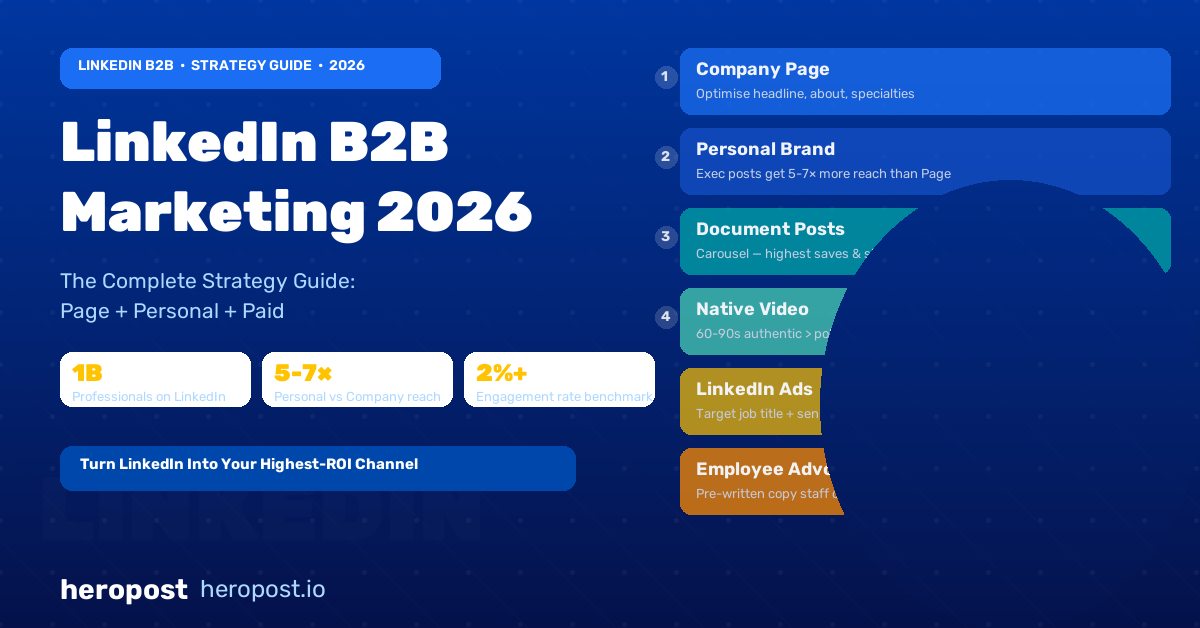
Personal posts on LinkedIn receive 5-7x more organic reach than Company Page posts. A founder with 10,000 followers publishing three times a week outperforms a Company Page with 50,000 followers publishing the same frequency.
The executive LinkedIn strategy:
Help your C-suite (especially CEO and Sales leadership) build active LinkedIn presences with consistent publishing. The content mix that works for B2B executives:
- Point-of-view posts on industry trends and developments
- Lessons from experience (specific stories from building the company)
- Honest commentary on challenges and failures (highest engagement type)
- Customer success stories (with permission)
- Commentary on news and events in the industry
Employee advocacy at scale:
For larger organisations, employee advocacy programmes — where employees are encouraged and equipped to share company content on their personal profiles — can dramatically amplify reach without paid media spend.
The key is making it easy: provide ready-to-share post text that employees can personalise, rather than generic company posts they are expected to share verbatim. Personalised shares receive dramatically higher engagement than unchanged corporate reposts.
LinkedIn Content Formats in 2026
Text posts: Still effective for thought leadership, insights, and short observations. Best performance comes from posts that lead with a counterintuitive statement, a strong opinion, or a surprising data point. Keep formatting clean — short paragraphs, line breaks, no hashtag stuffing.
Document/carousel posts: LinkedIn’s document format (PDF uploads that display as swipeable slides) remains the highest-engagement format for educational content. “X frameworks for Y” and “how to do X in N steps” in carousel format consistently outperform other content types for saves and shares.
Native video: Short-form (60-90 seconds) authentic video now gets stronger organic reach than polished long-form video. Interview format, whiteboard explainers, and “talking head” commentary videos all perform well. Captions are essential (most LinkedIn video is watched silently).
LinkedIn Articles: Long-form articles get limited organic reach but rank well in search — both LinkedIn internal search and Google. Use articles for comprehensive guides and thought leadership pieces that you want to be discoverable over time.
LinkedIn Newsletters: Building a LinkedIn Newsletter subscriber base gives you guaranteed delivery to subscribers’ notifications and inboxes — more reliable reach than standard posts for your most engaged audience. Ideal for regular analysis, market commentary, or educational series.
LinkedIn Ads for B2B
LinkedIn Ads are expensive — CPCs and CPMs are 3-5x higher than equivalent placements on Facebook or Instagram. They are also, for many B2B companies, the highest-quality paid traffic available.
Why LinkedIn Ads cost more and deliver more:
LinkedIn’s targeting allows you to reach specific job titles, seniority levels, company sizes, industries, and companies by name. If you are selling to HR Directors at companies with 500-5,000 employees in financial services, LinkedIn can put your ad in front of exactly that audience. No other platform offers this precision.
LinkedIn Ads formats that work for B2B:
- Sponsored Content (InFeed): Native posts that appear in the feed. Best for content promotion (guides, webinars, case studies) and brand awareness campaigns.
- Message Ads (InMail): Direct messages to LinkedIn inboxes. Higher CPL but higher engagement for specific high-value offers (event invites, direct meetings).
- Lead Gen Forms: Forms that pre-populate with LinkedIn profile data when a user clicks, dramatically increasing completion rates for content downloads and webinar registrations.
- Conversation Ads: Branching message-based ads that guide prospects through a decision tree. Works well for qualifying and segmenting leads.
LinkedIn Ads strategy for B2B:
Start with retargeting — targeting people who have visited your website, watched your video content, or engaged with your Company Page. This audience already knows you and converts at dramatically lower cost than cold targeting.
For cold audiences, lead with content value rather than product pitches. A “2026 State of [Industry]” report or a webinar on a challenge your buyers face will outperform “Book a demo” offers for cold LinkedIn traffic.
LinkedIn Analytics: What to Track
Company Page metrics:
- Impressions and Reach: How widely your content is being distributed. Declining reach indicates algorithm changes or content quality issues.
- Engagement rate: Total engagements / impressions. Benchmark: 2-3% is average, 5%+ is strong.
- Follower growth: Month-over-month follower growth rate. A flat or declining rate signals content or positioning issues.
- Visitor demographics: The job titles, seniority, and company sizes of your page visitors — critical for validating whether you are reaching your target buyer persona.
Content-level metrics:
Track which post types, topics, and formats drive the most engagement and reach, then systematically do more of what works. The data is the strategy.
Conclusion
LinkedIn for B2B is not a quick win — it is a platform that rewards consistent, high-quality content over time, with compounding returns as your following and credibility grow. The companies that treat it seriously, invest in personal brand alongside Company Page, and publish content their buyers actually find useful, consistently outperform those that treat it as a press release distribution channel.
The opportunity is substantial. Most companies are still not doing LinkedIn well. That means the bar for standing out is lower than it looks.
Heropost integrates LinkedIn publishing alongside your other social platforms, so you can plan, schedule, and analyse your LinkedIn content in one place. Start your free trial at heropost.io.