When TikTok first emerged as a platform, most small business owners dismissed it as a place for teenagers to dance. That was a mistake that cost many brands years of organic reach. In 2026, TikTok is arguably the most powerful organic growth platform available to businesses of any size — and small businesses are uniquely positioned to win on it.
Unlike Instagram or LinkedIn, where followers are hard-won and algorithmic reach has declined sharply for pages with small audiences, TikTok’s algorithm serves content based on quality and relevance — not account size. A small business with zero followers can publish a video today that reaches 100,000 people tomorrow. This happens regularly. It is not an accident. It is by design.
This guide gives small business owners the complete TikTok strategy for 2026: how to set up your account, what content to create, how often to post, and how to turn TikTok viewers into paying customers.
Why TikTok Works Differently for Small Businesses
The core difference between TikTok and every other platform is its discovery architecture. On TikTok, the default experience is the For You Page (FYP) — a personalised feed of content from accounts the user does not follow. The algorithm analyses watch time, replays, shares, and comments to determine which content to distribute widely.
This means:
Your content competes on merit, not history. A new account posting genuinely useful or entertaining content can reach the same audience as a brand with millions of followers. The playing field is unusually level.
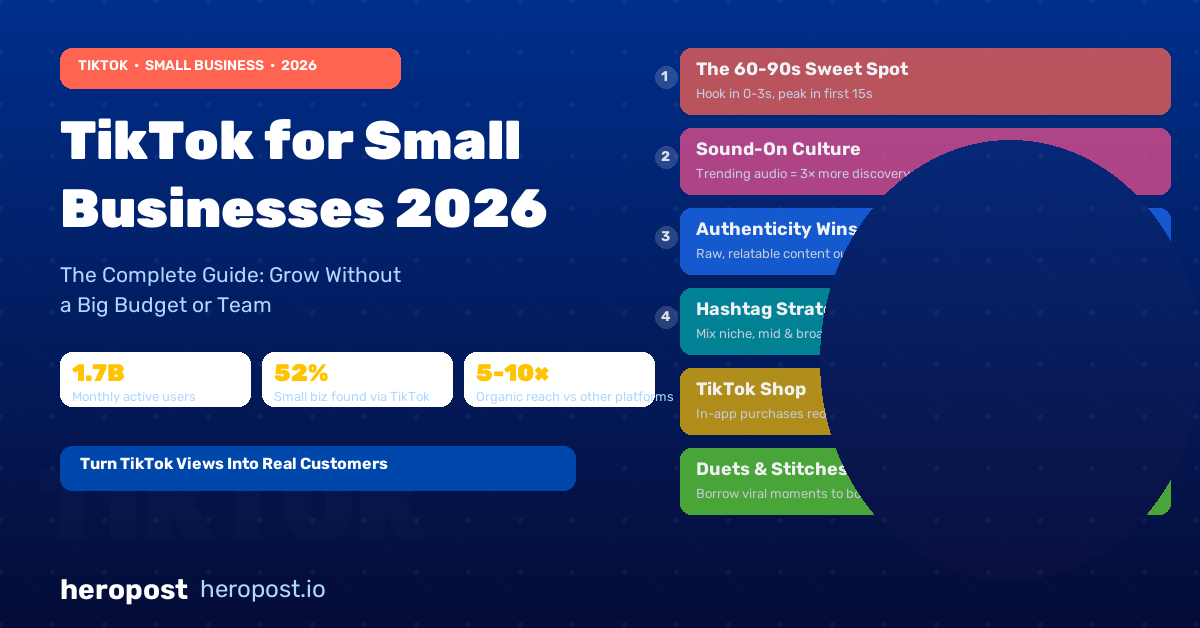
Authenticity outperforms production value. TikTok viewers have developed a strong preference for raw, real content over polished advertising. A behind-the-scenes video of your workshop filmed on an iPhone can outperform a professionally produced brand film.
Niche audiences are highly accessible. TikTok’s algorithm is exceptionally good at finding niche communities. #BookTok, #CleanTok, #FoodTok, #FitTok — these are vast, engaged communities of people with specific interests. If your business serves a niche, TikTok is where your audience lives.
Setting Up Your TikTok Business Account
Start with a business account rather than a personal account. TikTok for Business gives you access to analytics, commercial audio libraries (important for avoiding copyright issues), and the ability to run paid ads if you choose to.
Profile setup checklist:
- Username: Use your business name or a close variation. Keep it consistent with your other social handles.
- Profile photo: Use your logo. Consistency across platforms builds brand recognition.
- Bio: You have 80 characters. Use them to state clearly what you do and who you serve. Include a relevant emoji.
- Link in bio: Connect to your website, a product page, or a link-in-bio tool like Linktree that lets you showcase multiple destinations.
- Category: Select the most accurate business category — this helps TikTok’s algorithm serve your content to the right audience.
What Content Works for Small Businesses on TikTok
The best TikTok content for small businesses falls into a handful of reliable categories:
Behind-the-scenes content
Show people what happens before the product reaches them. The manufacturing process, the packaging operation, the team culture, the day in the life of the founder. This type of content builds genuine connection because it shows the human beings behind the brand.
A candle maker showing the pouring process. A bakery showing the 4am prep. A furniture maker showing the joinery. These videos regularly go viral because viewers find them both fascinating and satisfying.
Educational content
Teach your audience something they want to know. This is especially powerful if you operate in a category where people have lots of questions. A personal finance advisor explaining tax concepts. A nutritionist debunking food myths. A plumber showing how to fix a minor leak. Educational content builds authority and earns shares.
Product demonstrations and tutorials
Show your product in action. Not a TV-style advertisement — a genuine demonstration of how the product works and what problem it solves. Better still, film a real customer using the product for the first time.
Trending sounds and challenges
TikTok has a distinct culture built around trending sounds, audio clips, and challenges. Participating in trends — when they are relevant to your brand — dramatically increases your discoverability. The trick is to adapt the trend to fit your business authentically rather than forcing it.
Responding to comments with video
TikTok allows you to respond to comments with a new video. This is an underused format for small businesses. Take a question from a customer or viewer, and answer it with a short video. This builds community, generates new content ideas organically, and demonstrates that there are real people behind the brand.
Posting Frequency and Timing
TikTok rewards consistency. The recommended frequency for small business accounts is three to five posts per week. Daily posting accelerates growth, but quality always takes priority over quantity — a single well-executed video outperforms five mediocre ones.
Timing: TikTok is a global platform and the algorithm distributes content over time rather than in a single burst, which means timing matters less than on Instagram. That said, posting when your specific audience is most active does improve initial engagement velocity, which influences algorithmic distribution. Use your TikTok analytics to identify when your followers are online.
Converting TikTok Viewers into Customers
Reach without conversion is vanity. Here is how small businesses convert TikTok viewers into customers:
Clear calls to action: Every video should have a purpose. At the end, tell viewers what to do: “Link in bio for 20% off,” “DM me for a free consultation,” “Visit the website for the full tutorial.” Be direct.
TikTok Shop: If you sell physical products, TikTok Shop allows you to tag products directly in videos and livestreams, enabling in-app purchases. This is one of the most powerful conversion tools available on any social platform in 2026.
Livestreaming: TikTok Live is a remarkably effective sales channel, particularly for physical product businesses. Going live once a week — showing products, answering questions, offering live-only discounts — builds a loyal community and drives direct sales.
Email capture: Use your link in bio to drive viewers to a landing page where they can sign up for your email list in exchange for a discount code or free resource. Converting social followers to email subscribers gives you an audience you own, not one you rent from TikTok.
Managing TikTok with a Social Media Tool
Posting consistently on TikTok alongside your other social channels is a significant time commitment. A social media management platform like Heropost allows you to schedule TikTok content in advance, manage your posting calendar across platforms from a single dashboard, and track performance metrics without jumping between apps.
For small business owners who are also running operations, handling customers, and managing finances, this kind of tool is not a luxury — it is a practical necessity for maintaining consistency without burnout.
Measuring Success on TikTok
The TikTok metrics that matter for small businesses:
- Video views and watch time: The core signal the algorithm uses to determine reach. High watch time indicates compelling content.
- Profile visits from videos: Indicates that viewers are interested enough to learn more — a strong signal of intent.
- Follower growth rate: Absolute follower count matters less than your growth trajectory.
- Link clicks: How many viewers are following through to your website or product page.
- TikTok Shop sales: If applicable, revenue generated directly from TikTok.
Review these metrics monthly. Identify what your highest-performing content has in common — topic, format, length, style — and produce more of it.
Conclusion
TikTok gives small businesses something rare: a genuine organic reach channel that rewards authenticity over budget. The businesses winning on TikTok in 2026 are the ones who show up consistently, share the real story behind their brand, and teach or entertain their audience rather than advertising at them. If you have been putting TikTok off, stop waiting. The algorithm does not care how long you have been on the platform. What it cares about is whether your content is worth watching.