Short-form video has become the dominant content format across social media. But brands and creators now face a decision that was much simpler a decade ago: with three major short-form video platforms competing for attention — TikTok, Instagram Reels, and YouTube Shorts — where should you invest your time and resources?
The honest answer is that the right choice depends on your audience, your goals, and your content style. But understanding how each platform works, who uses it, and what it rewards will help you make a strategic decision rather than a guesswork one.
This guide provides a thorough 2026 comparison of all three platforms across the dimensions that matter most for brands and creators.
Platform Overview
TikTok
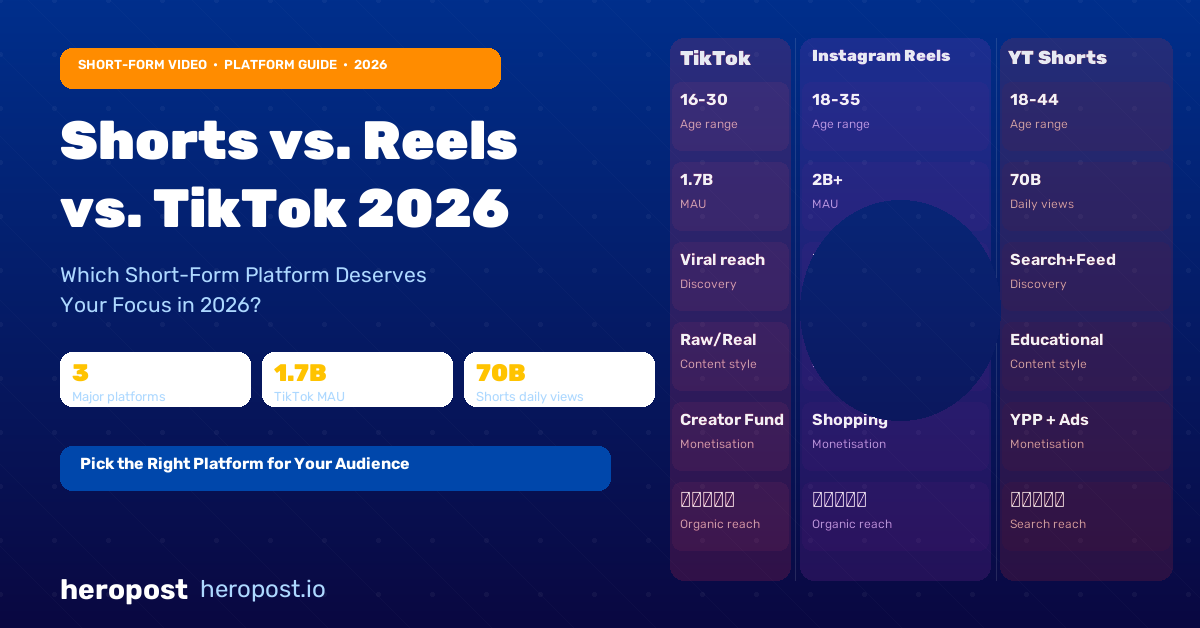
TikTok is where short-form video culture originated and where it remains most vibrant. The platform has approximately 1.7 billion monthly active users globally and is the primary entertainment platform for users aged 16-30. TikTok’s algorithm is the most sophisticated short-form discovery engine in existence — content from new accounts can reach millions of views within days if it resonates with viewers.
TikTok’s culture values authenticity over production quality, humour and entertainment as primary hooks, fast-paced editing, trending sounds and audio, and genuine creator personality.
Instagram Reels
Instagram Reels launched in 2020 as a direct response to TikTok and has grown substantially. With Meta’s advertising infrastructure and Instagram’s existing user base of over 2 billion, Reels has significant scale. It skews slightly older than TikTok (primary demographic 18-35) and tends to reward higher-quality production compared to TikTok’s rawer aesthetic.
The key advantage of Reels is its integration with the broader Instagram ecosystem — Reels content is discoverable on the Explore page and in followers’ feeds, creating multiple distribution pathways. Brands already active on Instagram can extend their reach through Reels without building an entirely new presence.
YouTube Shorts
YouTube Shorts was Google’s entry into the short-form video market and has grown to over 70 billion daily views. YouTube’s fundamental advantage is search — YouTube is the world’s second-largest search engine, and Shorts content is now indexed and surfaced in standard YouTube search results. This means a well-optimised Short can drive discovery through search queries in a way that TikTok and Reels cannot match.
YouTube Shorts also uniquely benefits from YouTube’s established creator monetisation infrastructure, making it attractive for creators building long-term revenue streams.
Audience Demographics
| Platform | Primary Age Range | Gender Split | Key Characteristics |
|---|---|---|---|
| TikTok | 16-30 | Roughly equal | Entertainment-first, high Gen Z |
| Instagram Reels | 18-35 | Slightly female | Lifestyle-oriented, fashion/beauty/food |
| YouTube Shorts | 18-44 | Slightly male | Search-intent, education, gaming |
If your target audience is under 30 and you want maximum organic reach potential, TikTok is your primary platform. If your audience is 25-40 and you are already active on Instagram, Reels is the natural extension. If your audience has search intent — they are looking for how-to content, tutorials, or explanations — YouTube Shorts should be in your mix.
Algorithm and Reach Potential
TikTok: The most powerful organic reach potential of any platform. Content from zero-follower accounts regularly achieves millions of views if the first few seconds capture attention and watch time is high. The algorithm distributes content in batches — showing it to a small group first, then expanding distribution if engagement is strong.
Instagram Reels: Organic reach has declined compared to TikTok and YouTube Shorts, partly because Meta is increasingly pushing paid distribution. That said, Reels still offers better reach potential than standard Instagram posts, and viral Reels can achieve significant scale. The platform rewards content that generates saves and shares alongside standard engagement.
YouTube Shorts: Reach comes from two sources — the Shorts feed (algorithm-driven, similar to TikTok) and YouTube Search (SEO-driven). The dual discovery pathway is a genuine advantage. Shorts that rank for search terms can drive consistent, compounding traffic for months or years.
Monetisation Comparison
TikTok: The TikTok Creator Fund pays poorly relative to view counts. TikTok Shop has become an increasingly effective revenue channel for product brands. Creator partnerships and affiliate deals are the primary income source for most TikTok creators.
Instagram Reels: Meta’s creator monetisation has been inconsistent. The primary revenue opportunities for brands are through Instagram’s broader shopping infrastructure, sponsored content partnerships, and traffic driven to external conversion points.
YouTube Shorts: YouTube’s Partner Programme now includes Shorts, with revenue generated from ads shown between Shorts. CPMs for Shorts are lower than long-form YouTube content but the volume potential is higher. For creators with both long-form and short-form content, Shorts serves as a discovery channel that feeds subscribers into a more monetisable long-form library.
Content Requirements and Production
TikTok: Best between 15-60 seconds. Hook in the first 1-2 seconds is critical. Native, on-screen captions improve watch time. Trending sounds increase discoverability. Relatively low production bar — authenticity matters more than polish.
Instagram Reels: Best between 15-30 seconds for highest completion rates, with longer formats (60-90 seconds) working well for tutorials. Higher production quality expected relative to TikTok. Text overlays and aesthetic consistency with your broader Instagram presence matter.
YouTube Shorts: Under 60 seconds for the Shorts feed. Keyword optimisation in title and description is more important than on other platforms due to the search discovery component. Thumbnail matters for click-through from search results.
The Strategic Recommendation
For most brands and creators in 2026, the answer is not one platform — it is two. Pick a primary platform and a secondary one:
- Primary: TikTok + Secondary: Instagram Reels — If your audience is under 35 and your goals are brand awareness and community building. Create natively for TikTok and repurpose to Reels (removing the TikTok watermark — Instagram’s algorithm penalises watermarked reposts).
- Primary: YouTube Shorts + Secondary: TikTok — If your content is educational, tutorial-based, or search-driven. YouTube Shorts builds a discovery channel for your long-form library while TikTok maximises organic viral potential.
- Primary: Instagram Reels + Secondary: YouTube Shorts — If your audience is 30-50 and you are already invested in the Instagram ecosystem. Reels maintains presence with your existing followers while YouTube Shorts captures search traffic.
Managing Multiple Short-Form Channels
Creating and publishing across three platforms manually is genuinely time-consuming. Using a social media management platform that supports cross-platform scheduling — like Heropost — dramatically reduces the operational burden. Create once, adapt slightly for each platform (primarily titles and captions), and schedule from a single dashboard.
Conclusion
YouTube Shorts wins on search and long-term traffic. TikTok wins on organic reach and cultural relevance. Instagram Reels wins on integration with existing Instagram audiences and Meta’s advertising infrastructure. There is no universally correct answer — but there is a correct answer for your specific business, audience, and content strategy. Focus on the platform where your audience spends time and where your content format works naturally. Build from there.