Social media and SaaS might seem like an unlikely pairing. Software products are intangible, often complex, and typically sold through long consideration cycles rather than impulse decisions. Yet some of the most successful SaaS brands in the world — HubSpot, Notion, Figma, Intercom — have built social media presences that drive massive organic awareness, reduce customer acquisition costs, and create communities so loyal that users become advocates.
The key difference between SaaS companies that win on social media and those that fail is simple: the successful ones treat social media as a community-building and education channel, not a sales channel. They lead with value — insights, tutorials, templates, opinions — and let the software speak for itself through demonstrated outcomes.
This guide covers the full SaaS social media strategy for 2026.
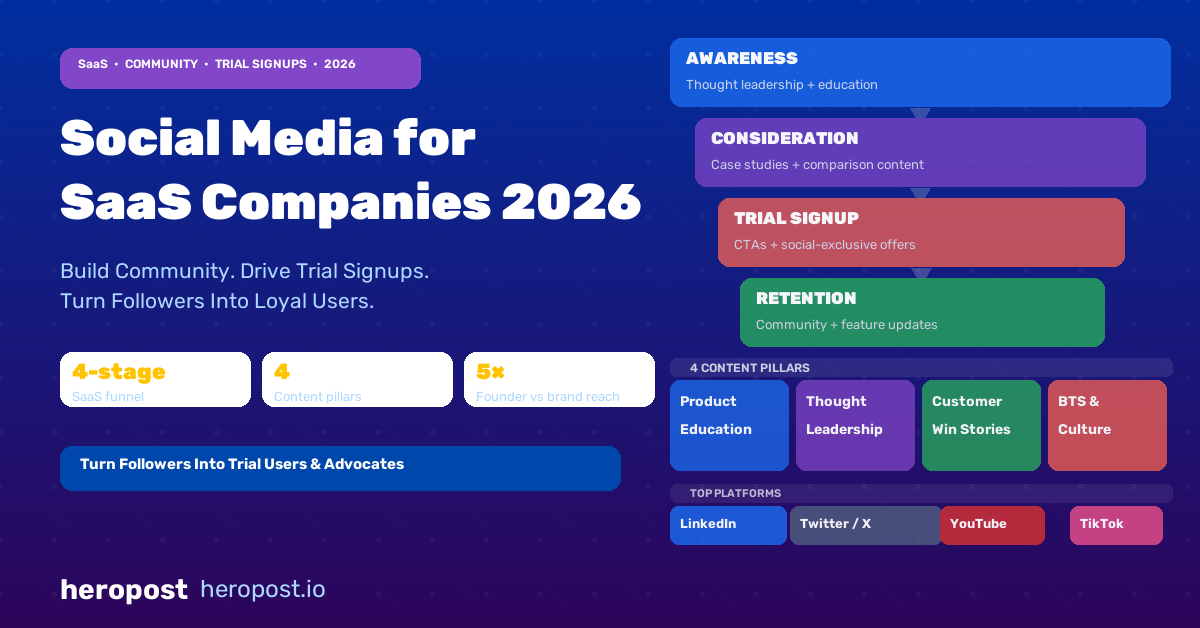
The SaaS Social Media Funnel
Awareness: Social media introduces potential customers to your brand, often before they know they have a problem your software solves. Educational content, thought leadership, and cultural commentary serve this stage.
Consideration: Once aware, prospects research alternatives. Social proof content — case studies, customer testimonials, comparison content, demo clips — helps prospects understand why your solution is the right choice.
Trial activation: Social media drives traffic to your website and trial signup page. CTAs in posts, links in bio, and social-exclusive offers convert social audiences into trial users.
Retention and community: Post-signup, social media becomes a retention tool. A strong community keeps users engaged with the product, exposed to new features, and connected to other users who reinforce their decision to stay.
Platform Strategy for SaaS
LinkedIn: The highest-priority platform for most B2B SaaS companies. Your buyers, champions, and potential advocates are on LinkedIn. Long-form posts sharing industry insights, frameworks, and product-adjacent education perform exceptionally well. Founder-led content consistently outperforms brand page content.
Twitter/X: Still an important platform for SaaS, particularly in the developer tools, DevOps, and startup tooling categories. X is where the SaaS operator community discusses strategy, shares wins and lessons, and debates ideas.
YouTube: Essential for complex SaaS products where video tutorials reduce the learning curve. A well-organised YouTube channel of product walkthroughs, integration guides, and feature explanations reduces support burden and increases activation rates.
TikTok and Instagram: Increasingly relevant for SaaS companies targeting SMB and individual professional users. Productivity tools, design software, and creator-adjacent SaaS products have found large audiences on TikTok in particular.
Content Pillars for SaaS Social Media
Pillar 1: Product education
Show what the product can do — but in the context of problems it solves, not features it has. Feature-led content (“we just launched X”) performs poorly compared to outcome-led content (“Here’s how to reduce your [specific problem] by [specific amount] using [your product]”).
Pillar 2: Industry thought leadership
Create content that would be valuable to your target audience even if your product did not exist. A project management SaaS sharing insights about remote team productivity. A finance SaaS sharing perspectives on cash flow management for SMBs. This pillar builds the audience and earns trust.
Pillar 3: Customer success stories
Real outcomes from real customers are the most persuasive content a SaaS company can publish. Quote testimonials, video case studies, and before-and-after metrics posts are direct conversion drivers.
Pillar 4: Behind-the-scenes and company culture
SaaS buyers increasingly want to know who they are buying from. Content about your team, your values, your product development philosophy, and your customer support approach builds trust that accelerates purchasing decisions and reduces churn.
Tactics That Work Specifically for SaaS
Founder-led social media: The data consistently shows that content from founders and executives outperforms brand page content on LinkedIn and Twitter/X. If you are a SaaS founder, your personal social media presence is potentially your highest-ROI marketing channel.
Social proof walls: Aggregate positive social mentions and testimonials and republish them on your brand channels (with permission). A weekly “what our users are saying” roundup is highly effective at reinforcing purchase decisions.
Feature launch content: Every product update is a social media opportunity. Frame launches in terms of user problems solved, not technical features shipped. “You asked for [solution to specific pain point] — here it is” creates anticipation and loyalty.
Community engagement: Respond to every comment, mention, and DM in the early stages of your social media growth. A tool like Heropost helps manage cross-platform engagement so mentions and comments do not fall through the cracks.
Measuring Social Media ROI for SaaS
- Trial signups attributed to social: Use UTM parameters on all social links to track which posts and platforms are generating trial signups
- MQL contribution from social: How many marketing-qualified leads originated from social media touchpoints?
- Community engagement rate: Are your users engaging with your content? Low engagement despite high follower counts indicates content/audience mismatch
- Share of voice: Are you appearing in the social conversations happening in your category?
- Net Promoter Score vs. social-sourced customers: Do customers who found you through social media have higher NPS?
Conclusion
The SaaS companies that build the most valuable social media presences in 2026 treat their channels as community hubs, not advertising channels. They lead with education, celebrate customers loudly, share authentic founder perspectives, and demonstrate product value through real outcomes. The result is not just awareness — it is a loyal, vocal user base that markets the product more effectively than any advertising campaign.