Every brand that operates on social media will eventually face negative comments, complaints, or — in the worst cases — a full-blown public crisis. There is no avoiding it. What separates brands that survive these moments and emerge stronger from those that suffer lasting damage comes down almost entirely to how they respond.
The good news is that the playbook for handling social media criticism is learnable, repeatable, and highly effective when applied with discipline. More importantly, handling a negative comment or crisis well is often an opportunity to demonstrate the quality and character of your brand in a way that no positive marketing can replicate.
The Spectrum of Social Media Negativity
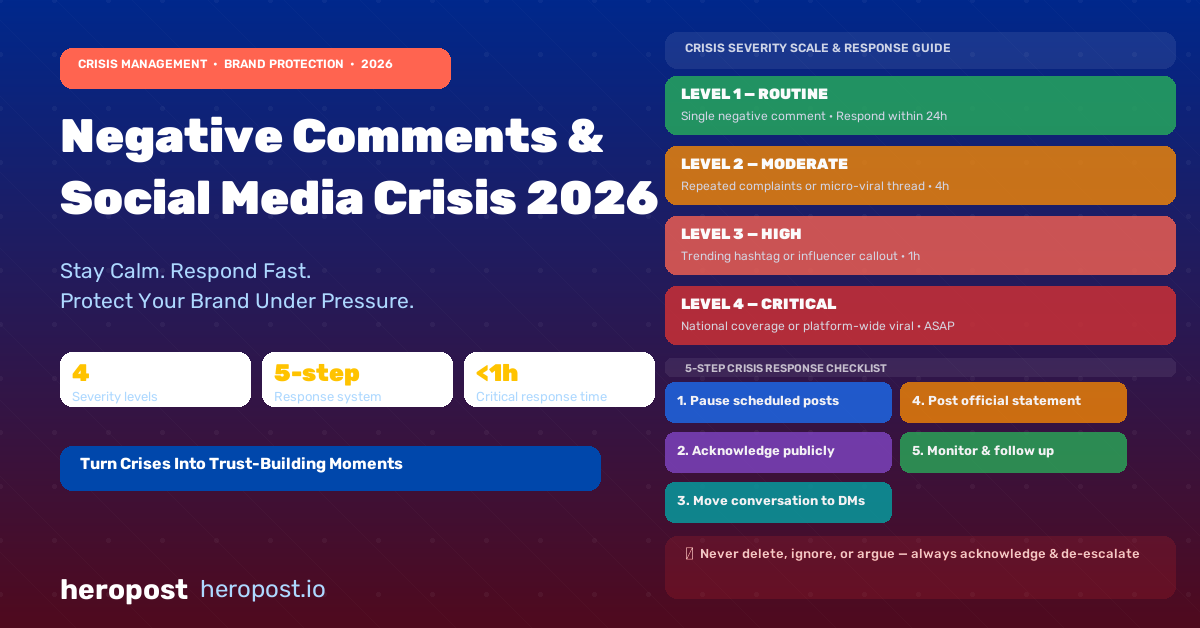
Tier 1 — Individual criticism or complaint: A customer had a bad experience and posted about it. This is routine and manageable. The goal is to acknowledge, apologise if warranted, and resolve publicly.
Tier 2 — Recurring negative sentiment: Multiple customers are expressing similar frustrations. This is a signal of a systemic issue that needs addressing at the product or service level, not just at the social media level.
Tier 3 — Coordinated negative campaigns: Organised groups deliberately targeting a brand, often with political or competitive motivations. Requires careful assessment of whether engagement helps or amplifies.
Tier 4 — Viral crisis: A single incident (a video, screenshot, or statement) has spread widely and is generating significant negative attention. Requires a formal, coordinated crisis response.
Tier 5 — Media-amplified crisis: The incident has moved beyond social media and is being covered by journalists and media outlets. Requires PR expertise alongside social media management.
Handling Negative Comments: The Core Principles
Respond, never ignore. Unanswered negative comments are not neutral — they are read as confirmation that the criticism is valid and that the brand does not care. Even a brief acknowledgement is better than silence.
Respond publicly, resolve privately. Acknowledge the issue in the public comment thread — ideally within one to two hours — then move the resolution to a private channel (DM, email, phone). Standard public response formula:
- Acknowledge the specific issue (show you read and understood their complaint)
- Apologise sincerely (without admitting legal liability)
- Invite them to continue the conversation in a private channel
- Keep it brief
Never argue, never be defensive. Even when a complaint is factually incorrect or clearly unfair, responding with defensiveness makes the brand look worse to every observer who was not previously invested in the outcome.
Match tone to context. A complaint about a delayed delivery warrants empathy and a direct resolution offer. A harmful misrepresentation of your brand warrants a calm, factual correction. A personal attack warrants no response at all.
The Social Media Crisis Response Playbook
When a single incident is spreading rapidly and generating significant negative attention, activate a structured response:
Step 1 — Assess immediately (first 30 minutes)
- What exactly happened? What is the complaint/criticism?
- Is it factually accurate?
- Who is affected (one person, many, a specific community)?
- How widely is it spreading?
- Is media coverage imminent or underway?
- What is the potential reputational and legal exposure?
Step 2 — Pause scheduled content (first 60 minutes)
Pause all scheduled social media posts immediately. Nothing is more tone-deaf than a cheerful brand post appearing in the middle of a crisis. Most social media scheduling platforms allow you to pause the queue with a single action.
Step 3 — Draft a statement (first 1-2 hours)
A crisis statement should include:
- An acknowledgement of the situation (not an admission of liability unless warranted)
- An expression of concern for those affected
- What you are doing in response
- Where stakeholders can get more information
Step 4 — Publish the statement and hold the line
Publish your statement on all relevant channels simultaneously. Then hold the position — responding to individual comments with empathy and directing people to the official statement rather than debating specifics.
Step 5 — Monitor and update
Crises evolve. As new information emerges or the situation resolves, update your public communication.
Step 6 — Post-crisis review
Within two weeks of the crisis resolving, conduct an internal review: What caused the crisis? Could it have been prevented? How effective was the response? What processes need to change?
Monitoring: Catching Issues Early
The biggest predictor of how well a brand handles social media crises is how quickly they know about them. Set up monitoring for:
- Direct brand mentions (@yourbrand)
- Untagged brand name mentions (keyword monitoring)
- Product names and common misspellings
- Key executives’ names
- Common complaint terms combined with your brand name
Social media management platforms like Heropost surface mentions and enable monitoring across multiple platforms from a single dashboard, allowing your team to catch and respond to issues before they escalate.
Turning Negative Moments into Brand-Building Opportunities
The brands remembered most positively for their social media crisis handling are often the ones who transformed a difficult moment into a demonstration of genuine values. Acknowledging mistakes honestly, compensating affected customers generously, and following through publicly on commitments to do better can leave a stronger positive impression than if the incident had never happened.
Conclusion
Negative comments and social media crises are not exceptional events — they are an inevitable feature of any brand operating publicly online. The brands that handle them well have two things: a clear playbook that removes the need to improvise under pressure, and a cultural commitment to responding with genuine empathy and accountability. Build the playbook now, before you need it. When the moment comes, you will be grateful you did.