The Best Times to Post on Social Media in 2026 (Platform-by-Platform Data)
 Heropost Team·Apr 12, 2026·6 min read
Introduction
If you are going to invest time creating great social media content, it makes sense to publish it when your audience is most likely to see and engage with it. Posting at peak engagement times does not just increase immediate reach — it improves algorithmic distribution on most platforms, creating a compounding benefit that extends the life of each post.
The challenge is that “best times” vary by platform, industry, audience geography, and account-specific audience behaviour. This guide covers the current data-backed best practices for 2026, along with the most important principle: how to find the optimal times specifically for your audience.
Why Timing Still Matters in 2026
Some marketers argue that with sophisticated algorithms, timing no longer matters — the algorithm will surface your content to the right people regardless of when you post. This is partially true but overstated.
Most platforms still give an initial distribution boost based on early engagement velocity. A post that gets strong engagement in the first 30-60 minutes of publication signals quality to the algorithm and is distributed more widely. If your audience is offline when you post, that initial engagement window is wasted — and the post never reaches its potential.
This means timing still has meaningful impact on reach, particularly on Instagram, LinkedIn, and Facebook.
TikTok is the notable exception — its algorithm is so sophisticated that content from months ago can resurface and go viral, making timing less critical. But even on TikTok, initial engagement matters for how quickly and widely content is distributed.
Best Times to Post on Instagram (2026)
Instagram engagement is highest during commute and lunch hours on weekdays, with evenings remaining strong.
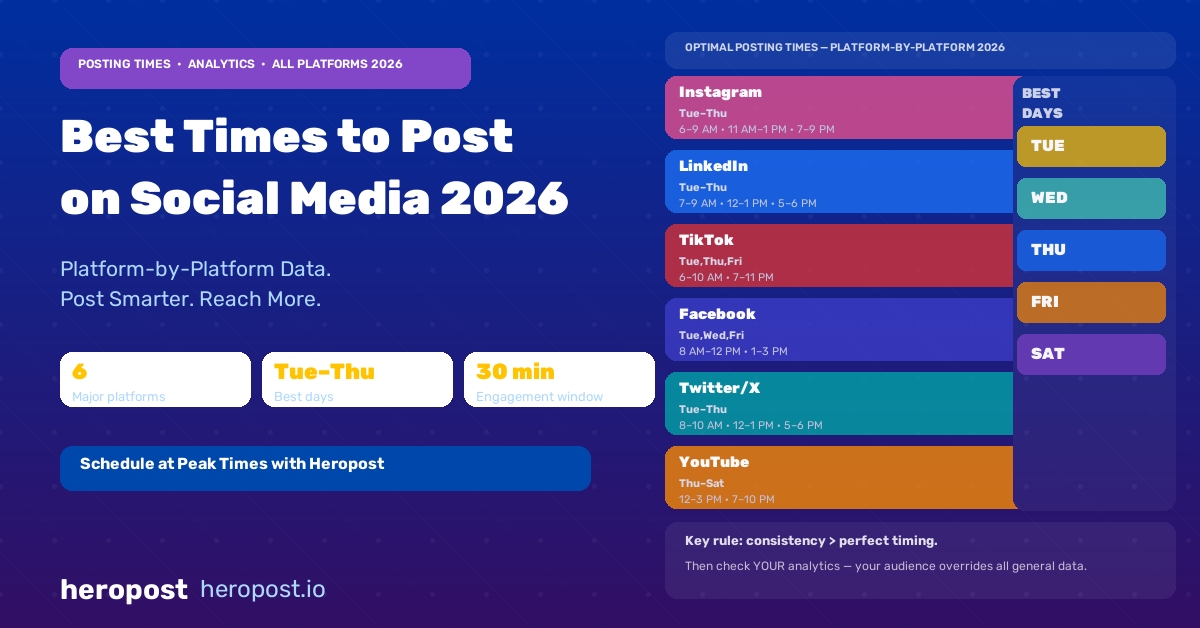
Best days: Tuesday, Wednesday, Thursday
Best times:
– 6:00 AM – 9:00 AM (morning commute)
– 11:00 AM – 1:00 PM (lunch break)
– 7:00 PM – 9:00 PM (evening relaxation)
Worst times: Early morning (before 5 AM), Sunday early morning, late night (after 11 PM)
Reels vs feed posts: Reels have somewhat different optimal windows and benefit from afternoon posting (2-4 PM) due to after-school and early afternoon audience peaks.
Key caveat: Instagram’s algorithm personalises the home feed heavily, meaning content can surface hours or days after posting. Stories and Reels, however, do benefit more directly from posting at peak times.
Best Times to Post on LinkedIn (2026)
LinkedIn is a professional platform and audience behaviour reflects this — peak engagement happens during working hours and the commute.
Best days: Tuesday, Wednesday, Thursday (Monday is still “catch-up” mode; Friday sees early drop-off)
Best times:
– 7:00 AM – 9:00 AM (pre-work and commute)
– 12:00 PM – 1:00 PM (lunch break)
– 5:00 PM – 6:00 PM (end of workday)
Worst times: Weekends (particularly Sunday), early morning (before 6 AM), late evening
Global considerations: LinkedIn is heavily used internationally. If your audience is global, consider a 9 AM post in a major timezone (EST or GMT) that captures both European morning and American morning audiences.
Best Times to Post on TikTok (2026)
TikTok’s algorithm is the least time-sensitive of any major platform, but early engagement still influences initial distribution speed.
Best days: Tuesday, Thursday, Friday
Best times:
– 6:00 AM – 10:00 AM (morning routine)
– 7:00 PM – 11:00 PM (evening entertainment)
Why evenings work on TikTok: TikTok’s primary use pattern is entertainment — people browse during leisure time rather than professional hours. The evening window captures the largest active audience simultaneously.
Best Times to Post on Facebook (2026)
Facebook’s audience skews older than TikTok and Instagram, with engagement patterns reflecting working adult and retiree schedules.
Best days: Tuesday, Wednesday, Friday
Best times:
– 8:00 AM – 12:00 PM (morning browsing)
– 1:00 PM – 3:00 PM (early afternoon)
Facebook Groups: Groups have different optimal times — engagement tends to peak later in the evening (7-9 PM) when members have time to read and respond at length.
Best Times to Post on Twitter/X (2026)
Twitter/X engagement is most concentrated during news and culture moments — morning news consumption and afternoon professional discussions.
Best days: Tuesday, Wednesday, Thursday
Best times:
– 8:00 AM – 10:00 AM (morning news consumption)
– 12:00 PM – 1:00 PM (lunch browsing)
– 5:00 PM – 6:00 PM (commute)
Breaking news moments: On Twitter/X, timing to real-world events (product launches, news stories, sporting events) often matters more than clock time. Being first and relevant during trending moments dramatically amplifies reach.
Best Times to Post on YouTube (2026)
YouTube watch time peaks in evenings and weekends, reflecting its role as an entertainment and long-form learning platform.
Best days: Thursday, Friday, Saturday
Best times:
– 12:00 PM – 3:00 PM (afternoon — catches both lunch break and early after-school)
– 7:00 PM – 10:00 PM (prime evening viewing)
Shorts vs long-form: YouTube Shorts follows a TikTok-like pattern and benefits from morning and evening posting. Long-form videos benefit from Thursday-Friday publishing, as weekend viewing drives significant completion-based engagement signals.
The Most Important Principle: Your Audience Data Overrides All Generalised Data
Every audience is different. A B2B software company’s LinkedIn audience behaves differently from a consumer brand’s LinkedIn audience. A fitness account’s Instagram audience has different peak activity times than a financial education account.
The generalised data above provides a useful starting point, but the most important source of timing data is your own account analytics.
How to find your optimal times:
Instagram and Facebook: Business accounts have access to Audience Insights, which shows when your specific followers are most active (by day and hour).
LinkedIn: Creator mode analytics show follower activity patterns for your specific audience.
TikTok: The TikTok Pro analytics dashboard shows follower activity hours and days.
YouTube: YouTube Studio provides detailed audience activity reports.
Review these analytics monthly. Audience behaviour shifts with seasons, content mix changes, and demographic evolution as your account grows.
Scheduling for Consistency Over Perfect Timing
The research consistently shows that posting frequency and consistency have a larger impact on long-term social media growth than any optimisation of posting times. An account that posts at 9 AM every Tuesday and Thursday will grow faster than an account that perfectly optimises posting times but posts irregularly.
Using a scheduling tool like Heropost, you can set your optimal posting windows once and let the tool handle publication automatically. This removes the daily cognitive overhead of remembering to post and ensures consistency even during busy periods.
Conclusion
Posting at the right time is a meaningful optimisation — it improves initial engagement velocity and algorithmic distribution on most platforms. But the biggest gains come from using your own analytics to find your audience’s specific activity patterns, and from prioritising consistency over perfect timing. Show up reliably. Optimise from there.
Schedule a month of content in one afternoon
Every network, one calendar, free to start.