Introduction
LinkedIn has evolved significantly from its origins as a professional CV platform. In 2026, it is the dominant professional social network — the place where business decisions are researched, where professional credibility is established, where B2B relationships are built, and where an increasing proportion of B2B revenue originates.
For B2B marketers, LinkedIn is not optional. It is the primary social media platform for reaching business buyers, influencing purchasing decisions, and building the brand authority that makes commercial conversations easier. This guide covers the complete LinkedIn strategy for B2B marketing in 2026.
Personal Brand vs Company Page — The Hierarchy
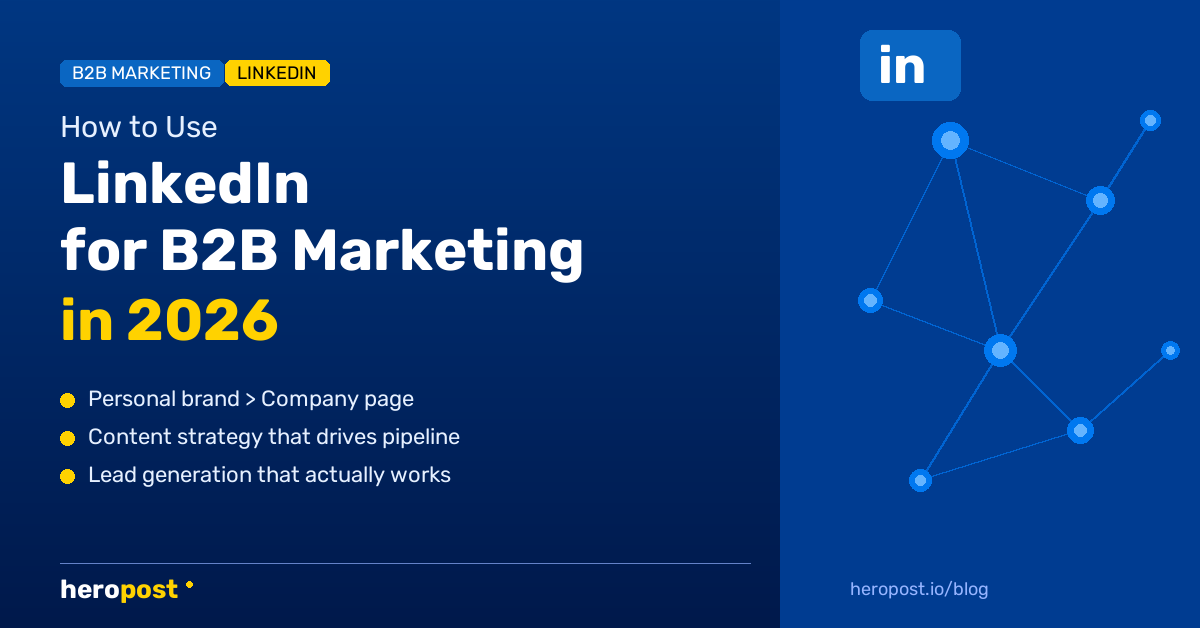
The most important thing to understand about LinkedIn in 2026 is the performance hierarchy between personal accounts and company pages.
Personal accounts consistently outperform company pages on almost every metric: organic reach, engagement rate, comment volume, and direct conversion to pipeline. LinkedIn’s algorithm distributes personal account content significantly more broadly than company page content, reflecting the platform’s fundamental purpose as a professional networking tool rather than a broadcast advertising channel.
The implications for B2B strategy:
- Founder, executive, and subject-matter-expert personal LinkedIn presence is your highest-leverage B2B social media investment
- Company page content should supplement personal content, not be the primary channel
- Sales team personal LinkedIn presence is a pipeline generation tool, not just a profile maintenance exercise
- Employee advocacy — systematically amplifying company content through employees’ personal networks — multiplies company page reach dramatically
LinkedIn Content Strategy for B2B
The three content types that perform best for B2B on LinkedIn:
1. Insight and perspective posts
Original thinking on the challenges, trends, or decisions your target buyer faces. Not generic industry commentary — specific, counterintuitive, or substantiated perspectives that demonstrate genuine expertise.
Format: 150-300 word text posts with a hook line, a substantive insight, and a clear implication. No links in the post body (LinkedIn’s algorithm deprioritises posts with outbound links — put links in the first comment instead).
Performance signal: high save rate and comment quality. If people are saving and sharing your posts, you are writing content that provides genuine value.
2. Specific, human story posts
The story of a specific client situation — the problem they faced, the approach you took, the result achieved. Or a specific professional experience — a mistake you made and what it cost, a decision that proved right in an unexpected way, a pattern you have observed across dozens of client engagements.
Specificity is the key ingredient. “I helped a client grow from $2M to $8M ARR in 18 months” is much less engaging than the specific story of how that happened, what the obstacles were, and what the turning point was.
3. Frameworks and structured thinking
Lists, processes, and frameworks perform strongly on LinkedIn because they provide immediate, extractable value. “The 5 questions I ask before taking on any new client,” “The framework we use for quarterly business reviews,” “3 signs a sales conversation is going wrong (and how to recover).” These posts get saved, shared, and remembered.
Company Page Optimisation
While personal content outperforms company page content organically, the company page serves critical functions:
Employer brand: Potential hires research company pages before applying. A well-maintained page with culture content, team spotlights, and regular updates converts interested candidates into applicants.
Credibility anchor: When a personal post generates interest and the reader clicks through to the company page, a professional, complete, up-to-date page converts that curiosity into a commercial consideration.
LinkedIn Ads foundation: LinkedIn advertising requires a company page. If paid LinkedIn is part of your strategy, the page needs to be in good shape.
Company page best practices:
– Complete the page fully: logo, banner, tagline, about section, specialities
– Post 2-3 times per week with a mix of thought leadership, team content, and product/service content
– Activate employee notifications so posts get employee engagement in the crucial first hour (which signals to the algorithm to distribute more broadly)
– Use LinkedIn Articles for long-form content that demonstrates depth of expertise
LinkedIn Lead Generation
LinkedIn is the most direct B2B pipeline generation platform available when used with a systematic approach:
Connection strategy: Connect with ideal customer profiles — specific job titles, company sizes, and industries that match your target buyer. Personalise connection requests with a relevant reference (a post they wrote, a mutual connection, a shared interest or experience). Generic connection requests convert poorly.
Content-to-conversation: When someone engages with your content (likes, comments, shares), this is a warm signal of relevant interest. Following up with a genuine, personal message that references their engagement converts content engagement into conversation without being spammy.
LinkedIn Sales Navigator: For systematic outbound prospecting, Sales Navigator’s advanced search and intent signals provide targeting precision unavailable in the free platform. If B2B pipeline generation is a commercial priority, the investment is typically justified.
Event hosting: LinkedIn Events — live sessions, webinars, fireside chats — build pipeline by putting you in front of an interested professional audience in a high-trust context. The follow-up after an event is a natural, low-friction opportunity to start commercial conversations.
Measuring LinkedIn Performance
For personal accounts: Reach and impressions (are you being seen?), engagement rate (are people finding it valuable?), profile views from content (are posts generating business interest?), direct pipeline conversations (the ultimate metric).
For company pages: Follower growth, post engagement, page views, career page performance (for employer brand goals), and LinkedIn Ads performance if running paid campaigns.
The metric that matters most: Are LinkedIn connections converting to sales conversations, qualified leads, or meaningful relationships that advance your commercial goals? Everything else is in service of this.
Conclusion
LinkedIn B2B marketing in 2026 is a long game played with consistent, high-quality content and genuine relationship investment. The companies and individuals that dominate LinkedIn in their niche are the ones that have been showing up with substantive content for 12-24 months — building the authority that makes them the obvious choice when a buyer is ready to engage. Start with personal brand, publish consistently, and measure the pipeline that results.