Introduction
The promise of social media automation is obvious: publish more content with less effort, respond faster, report more efficiently. The risk is equally clear: automate too aggressively and your social presence becomes a robotic broadcast channel that nobody wants to engage with.
The brands with the most effective social media operations in 2026 have found the right balance — automating the repeatable, time-consuming operational tasks while keeping the human creativity, judgment, and relationship management that makes social media worth doing in the first place.
This guide draws a clear line between what should be automated and what should never be.
What to Automate
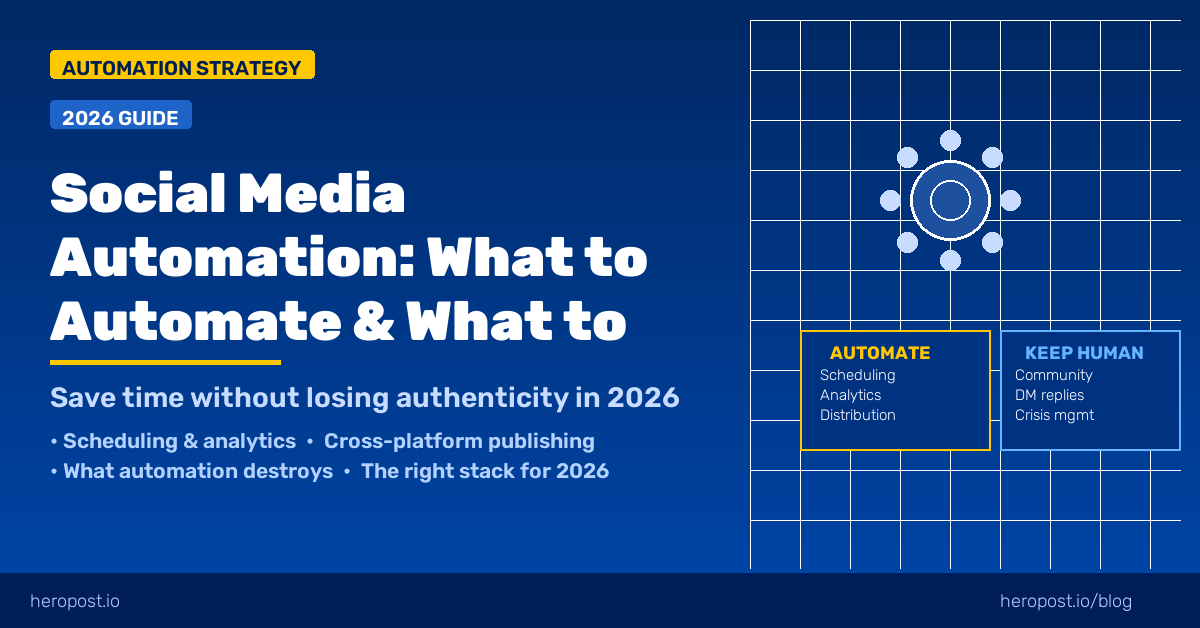
Scheduling and publishing
The most universal and high-value automation in social media is scheduled publishing. Writing and scheduling content in advance — using a tool like Heropost — removes the daily pressure of “what do I post today” and allows content creation to happen in dedicated, focused sessions rather than ad hoc throughout the week.
Automation enables: consistent posting frequency regardless of what else is happening in the business, publishing at optimal times regardless of your timezone or schedule, and multi-platform distribution from a single interface.
Cross-platform distribution
Manually publishing the same (or adapted) content across multiple platforms wastes significant time. Scheduling tools that enable single-entry multi-platform publishing — with platform-specific formatting adjustments — are straightforward automation wins.
Analytics reporting
Pulling weekly and monthly performance data manually from each platform’s native analytics is time-consuming and error-prone. Automated reporting that aggregates data from multiple platforms into standardised dashboards saves hours of manual work and produces more consistent, comparable data over time.
Monitoring and alerts
Social listening tools that monitor for brand mentions, competitor activity, and relevant keyword conversations can run continuously without human attention, surfacing only the results that require action. This is a significant upgrade over manual monitoring.
Inbox management and routing
For high-volume accounts, automating initial DM responses — acknowledgment messages that set expectations for response time — and routing conversations to the appropriate team member improves response time without requiring constant human attention on the inbox.
What Not to Automate
Community responses and genuine conversation
Automated comment replies are immediately detectable and consistently damage brand perception. When a follower leaves a thoughtful comment on your post, a bot-generated response — even a well-crafted one — is an insult to the genuine engagement they offered. Human community management is non-negotiable.
DM conversations beyond initial acknowledgment
The initial “thanks for reaching out, we will reply within 24 hours” can be automated. The actual conversation that follows cannot. Sales conversations, customer service resolution, and relationship development require human judgment, empathy, and flexibility that no automation can replicate.
Content creation and original voice
AI-generated content has reached a quality level where it can be useful for ideation, drafts, and structural frameworks — but content published under a brand voice that was written entirely by AI without human creative judgment tends to be generically competent at best and actively off-brand at worst. Use AI as a writing assistant, not a replacement.
Crisis response
When a brand crisis occurs — a negative story, a customer incident, a public controversy — social media response requires human judgment, legal awareness, leadership input, and genuine empathy. Any automation running during a crisis (scheduled posts going out, automated responses triggering) can make situations dramatically worse. All automation should have an emergency pause capability.
Influencer and partnership outreach
Automated influencer outreach is among the most commonly disliked practices in creator communities. Personalised, specific, human outreach that references the creator’s actual work converts dramatically better than templated bulk outreach — and protects your brand reputation in creator networks.
The Right Automation Stack
A well-configured social media automation setup typically includes:
Scheduling platform (e.g., Heropost): Content creation, scheduling, approval workflows, cross-platform publishing, calendar management.
Social listening tool: Brand mention monitoring, sentiment tracking, competitor activity alerts, keyword monitoring.
Analytics aggregation: Cross-platform performance dashboards, automated weekly/monthly reports.
Community management tool: Inbox management, conversation routing, response time tracking.
The principle: automate workflows, not relationships.
Conclusion
Social media automation in 2026 is a competitive necessity for any team managing multiple accounts or platforms at scale. But the automation ceiling — the point at which more automation starts hurting rather than helping — is lower than most brands realise. The relationships, creativity, and judgment that make social media worth investing in are irreducibly human. Automate the operations; protect the humanity.