Social media followers are rented. Email subscribers are owned.
That distinction matters enormously. When a platform changes its algorithm, restricts organic reach, or — in the most extreme case — disappears, your social media following can vanish overnight. Your email list stays with you. It is a direct line to your audience that no platform can take away.
The smartest marketers in 2026 use social media as a follower acquisition channel and email as their primary owned distribution channel. They build lists from followers, and then use email to deepen relationships that social media starts.
This guide shows you exactly how to convert social media followers into email subscribers — platform by platform, tactic by tactic.
Why Building an Email List Still Matters in 2026
Email marketing has consistently delivered the highest ROI of any marketing channel for over a decade. In 2026, despite the rise of DMs, push notifications, and social messaging, that has not changed.
The numbers are clear:
- Average email open rates of 20-40% vastly outperform organic social reach (1-5% on most platforms)
- Email click-through rates average 2-5%, compared to well under 1% for most social posts
- Email subscribers convert to buyers at significantly higher rates than social followers
The relationship is different. Someone who gives you their email address has made an active choice — they are not just a passive follower who happened to see your post. That intent translates to engagement and conversion.
The Core Conversion Mechanism: The Lead Magnet
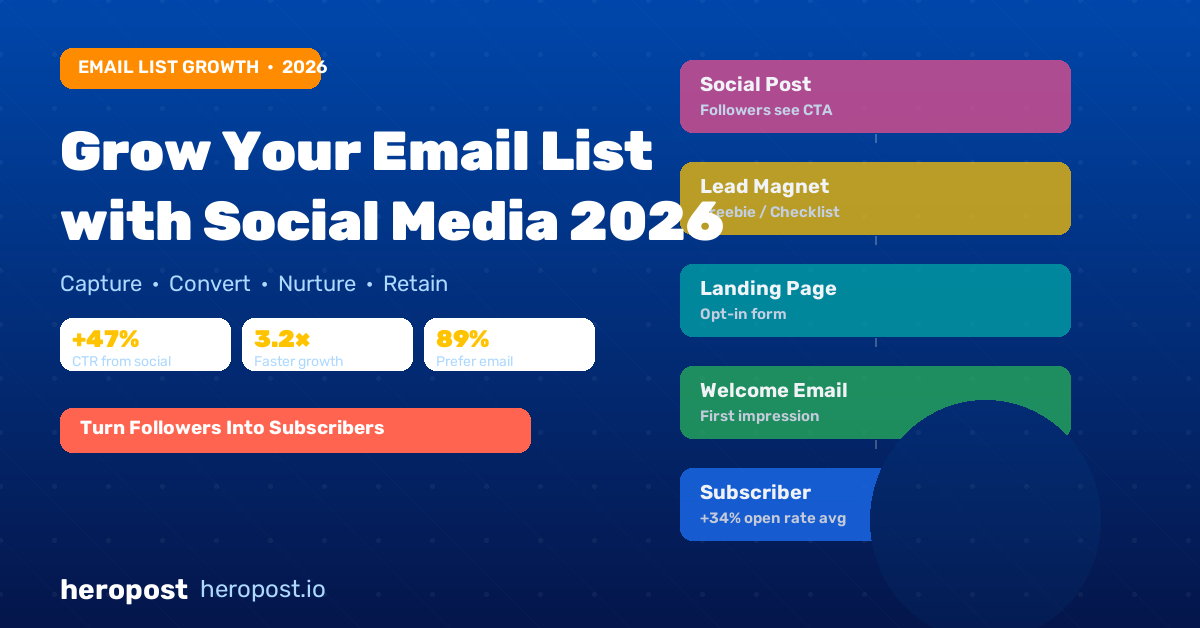
The most effective way to convert a social media follower into an email subscriber is to offer something genuinely valuable in exchange for their email address. This is called a lead magnet.
A lead magnet works because it removes the friction of subscribing. Instead of asking someone to “sign up for our newsletter” (why would they? newsletters are a commodity), you offer them a specific, tangible piece of value they can get right now by providing their email.
What makes a great lead magnet:
- Specific: “The 30-second morning routine” beats “health tips”
- Immediately useful: Solves a problem the person has right now
- Relevant to your business: Attracts people who will eventually become customers
- Easy to deliver: PDF, checklist, template, mini-course, video — something you can set up to deliver automatically
Lead magnet ideas by category:
For content creators and educators:
- “The [topic] Toolkit” — curated list of resources
- Mini email course (5 days of lessons delivered daily)
- Template library or Notion dashboard
- Printable checklist or workbook
For e-commerce brands:
- Discount on first order (classic, still works)
- Style guide, care guide, or how-to PDF relevant to your products
- Early access or waitlist for new collections
For service businesses:
- Free audit, assessment, or consultation (time-gated)
- Case study or results report
- Pricing guide or buyer’s checklist
For SaaS and apps:
- Extended free trial or additional features
- Onboarding guide or video training library
- Data report or benchmark study
Platform-by-Platform: Converting Followers to Subscribers
Instagram’s architecture makes email capture slightly more complex than other platforms, but the engaged audience quality makes it worth the effort.
Link in bio: Your primary conversion mechanism. Use a link-in-bio tool to offer your lead magnet clearly. The top option should be “Download [lead magnet]” — not “Visit our website” or “Shop now.”
Stories with link stickers: Instagram Stories allow direct links. Create a simple Story: “Free [lead magnet] — tap the link” with your sign-up URL. Run this regularly, not just once.
Direct CTA in captions: End relevant posts with “Link in bio to get your free [lead magnet].” Simple, direct, consistent.
DM automation: Set up a keyword trigger so when someone DMs a specific word (“GUIDE,” “FREE,” “TEMPLATE”), they automatically receive your lead magnet link. This dramatically reduces friction. Tools like ManyChat handle this.
Instagram Notes: Use the Notes feature (visible to your followers at the top of DMs) to promote your lead magnet with a single short line.
TikTok
TikTok does not allow clickable links in captions, but several workarounds drive strong email capture.
Bio link: TikTok allows one link in your bio. Make it your lead magnet landing page, not your homepage.
Verbal CTA in video: In the video itself, say “I have a free [lead magnet] — the link is in my bio.” This is significantly more effective than text CTAs because TikTok’s audience is watching, not reading.
Lead magnet content: Create videos that tease your lead magnet. “I created a 5-day email course on [topic]. Here is what you will learn on Day 1…” — then direct to bio for the full course.
LinkedIn is excellent for B2B email list building because the audience is self-selected as professionals interested in your topic.
Newsletter feature: LinkedIn newsletters build a following within LinkedIn and notify followers when new issues publish. Include a CTA in every edition: “For the full version, subscribe at [link].” This captures subscribers who want a direct relationship outside LinkedIn.
Lead gen forms with LinkedIn Ads: LinkedIn’s native lead gen forms pre-fill with profile data, dramatically reducing form abandonment. Even modest ad spend with a strong lead magnet can generate high-quality B2B subscribers.
Document posts: PDF carousel posts on LinkedIn drive high engagement and can include CTAs at the end: “Download the full version at [link].”
Posts with landing page links: Unlike Facebook, LinkedIn does not heavily suppress posts with external links. Including your lead magnet link directly in a post is viable.
YouTube
YouTube is a powerful email list builder because the audience actively searches for content about your topic — they have high intent before they ever see your video.
Video description links: Put your lead magnet link in the first two lines of every video description. YouTube shows only the first 100 characters before the “show more” fold.
Verbal CTA mid-video: Mention your lead magnet mid-video, not just at the end. “Before I continue — I’ve created a free [lead magnet] that goes deeper on this. Link is in the description.”
End cards: YouTube end cards can link to external URLs. Use one end card for your lead magnet consistently across all videos.
Community posts: YouTube’s Community feature lets you post updates to subscribers. Regular Community posts promoting your lead magnet reach your existing YouTube audience.
Facebook Groups: If you run a Facebook Group, the join approval questions can include “Enter your email to receive [lead magnet].” This converts group members into subscribers at the point of joining.
Pinned posts: Pin a post promoting your lead magnet to the top of your Group and Page. New visitors see it immediately.
Facebook Ads: Facebook’s lead gen ads (native forms) convert extremely well when paired with a compelling lead magnet. The pre-filled form data means minimal user effort.
The Opt-In Page: Maximising Conversion
All your social traffic goes somewhere. That somewhere needs to convert.
A high-converting lead magnet opt-in page includes:
A specific headline that communicates what the person gets and what problem it solves. “Get the 27-point social media content checklist” beats “Subscribe to our newsletter.”
A brief description of what they are getting and who it is for. 2-3 sentences maximum.
Social proof — if you have it. “Download the guide 12,000 marketers are already using.”
A single form field. Name + email is standard. Email only converts higher. Ask for no more than you need.
A clear CTA button with specific language: “Send me the guide,” “Get instant access,” “Download now” — not the generic “Submit.”
Mobile optimisation. Over 70% of your social traffic arrives on mobile. If your opt-in page is not seamless on a phone, you are losing most of your conversions.
Nurturing: What to Do After They Subscribe
Growing your list is half the job. The other half is building the relationship that makes subscribers stay, engage, and eventually buy.
Welcome sequence: The first email (or series of 3-5 emails) you send after someone subscribes sets the tone for the entire relationship. Welcome them, deliver the lead magnet, introduce yourself, and begin demonstrating value immediately. This is not the place for a sales pitch.
Consistent value delivery: Email your list regularly (at minimum monthly; weekly is better for most businesses). Content should be genuinely useful — not just promotional.
Segment by interest: As your list grows, segment subscribers by what lead magnet they signed up for and what content they engage with. More relevant emails drive higher open rates and conversions.
Integrate with social: Use your email list to amplify social posts (“We published a new guide — here is the link”), and use social to re-engage email subscribers who have gone cold.
Conclusion
Social media and email are complementary, not competing channels. Social media’s reach and discoverability build your audience. Email’s directness and ownership build your business.
The strategic imperative is to create the bridge: content that attracts followers, lead magnets that convert them to subscribers, and email sequences that deepen the relationship into customers.
Start with one lead magnet and one platform. Build the conversion system. Then expand.
Heropost helps you manage the social media side of the equation — schedule your list-building content across all platforms, track what drives the most engagement, and keep your pipeline consistent. Start your free trial at heropost.io.