
The most time-efficient social media teams in the world are not creating more content — they are getting more out of the content they already create.
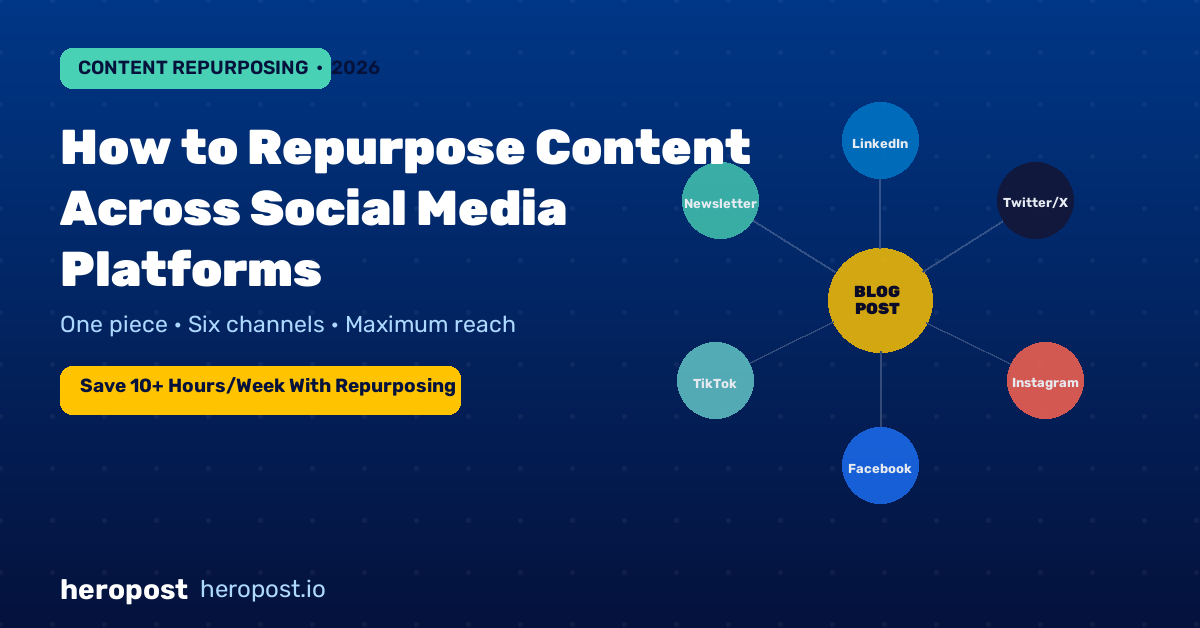
Content repurposing is the practice of taking one core piece of content and adapting it into multiple formats for multiple platforms. A single 2,000-word blog post can become 10 LinkedIn posts, 3 Instagram carousels, a YouTube script, 5 TikTok videos, and an email newsletter — with a fraction of the effort required to create each from scratch.
This guide shows you how to build a repurposing system that multiplies your content output without multiplying your time investment.
Why Content Repurposing Works
Different audiences consume content differently. Your Instagram followers may never read your blog. Your LinkedIn connections may not see your TikTok videos. Repurposing ensures your best ideas reach your entire audience, not just the segment that happens to read your blog.
Repetition builds recall. Marketing research consistently shows that prospects need multiple exposures to a message before it registers. Seeing the same core idea on three different platforms reinforces the message in a way a single touchpoint never could.
Not all content performs equally on all platforms. A long-form blog post may get 500 views. The same content broken into five LinkedIn posts might collectively reach 50,000 people. Repurposing lets you find the format that works best for each idea.
It respects the algorithm. Each platform rewards consistent posting. Repurposing gives you the volume to post consistently without burning out your team.
The Content Repurposing Pyramid
Think of content creation as a pyramid:
Top: Long-form content (the source material)
Blog posts, podcast episodes, YouTube videos, webinars, research reports, white papers. These are high-effort pieces that contain multiple ideas, insights, and supporting arguments.
Middle: Medium-form derivatives
LinkedIn articles, email newsletters, Instagram carousels, Twitter/X threads, Pinterest boards. These adapt specific sections or arguments from the source material for specific platforms.
Bottom: Short-form atoms
Individual LinkedIn posts, Instagram captions, TikTok scripts, quote graphics, short Reels. These extract individual insights, stats, or arguments from the source material into standalone posts.
One long-form piece at the top of the pyramid generates everything below it.
The Step-by-Step Repurposing System
Step 1: Create the pillar piece
Start with your best, most comprehensive piece of content. This is your source material — the piece that contains the most value and from which everything else will be derived.
Ideal pillar content for repurposing:
- Long-form blog posts (1,500+ words)
- Podcast episodes (30+ minutes)
- YouTube videos (10+ minutes)
- Webinar recordings
- Original research reports
Step 2: Extract the key ideas
After creating the pillar piece, spend 20 minutes extracting the raw ingredients:
- Data points and statistics: Any specific numbers, percentages, or research findings
- Frameworks and models: Any structured approaches, step-by-step processes, or decision frameworks
- Quotes and insights: Memorable sentences that could stand alone as posts
- Counter-intuitive claims: Any statements that challenge conventional wisdom
- Lists: Any bulleted or numbered lists that could become carousel slides or Twitter threads
- Questions: Any questions you pose in the piece that could become standalone posts
A 1,500-word blog post typically yields 8-15 repurposable assets.
Step 3: Match assets to platforms
| Content Type | Best Platforms |
|---|---|
| Data/statistics | LinkedIn, Twitter/X, Instagram carousel |
| Step-by-step frameworks | LinkedIn carousel, Instagram carousel, TikTok |
| Quote insights | LinkedIn, Twitter/X, Instagram Stories |
| Video explainers | YouTube (long), TikTok/Reels (short) |
| Comprehensive lists | LinkedIn, Pinterest, email |
| Counter-intuitive takes | LinkedIn, Twitter/X |
| Behind-the-scenes | Instagram Stories, TikTok |
Step 4: Adapt, don’t just copy
Repurposing is adaptation, not copy-paste. Each platform has its own language, format expectations, and audience behaviours.
A LinkedIn post that works starts with a hook, delivers value in short paragraphs, and ends with a question or CTA. An Instagram carousel starts with a bold headline slide, delivers one insight per slide, and ends with a save-worthy summary. A TikTok starts with a visual hook in the first second and tells a story through edits and captions.
The idea is the same. The execution is platform-native.
Step 5: Schedule in batches
The efficiency of repurposing breaks down if you create each derivative piece individually as needed. Instead:
- After publishing a pillar piece, block 2 hours to create all derivatives at once
- Schedule everything using a social media management platform like Heropost
- Space publication across the following 2-3 weeks so the same idea does not appear everywhere simultaneously
Practical Repurposing Examples
From a blog post: “10 LinkedIn Post Ideas That Actually Get Engagement”
Derivatives:
- LinkedIn post — hook: “Most LinkedIn posts fail for the same reason” + deliver one insight from the post
- LinkedIn post — hook: “I analysed my top 10 LinkedIn posts. Here is what they had in common” + share the framework
- Instagram carousel — “10 LinkedIn post types that get engagement” (one per slide)
- TikTok — “The LinkedIn post format that got me 50,000 views” (show the template)
- Twitter/X thread — the full list with brief commentary on each
- Email newsletter section — “This week: what’s actually working on LinkedIn”
- Pinterest infographic — visual summary of the 10 post types
- LinkedIn poll — “Which of these LinkedIn content types do you find most valuable?”
That is 8 pieces of content from one blog post.
From a podcast episode: Interview with a successful social media manager
- YouTube long-form — full interview published on YouTube
- YouTube Shorts — 3-5 clips of the most quotable moments (60 seconds each)
- LinkedIn post — “5 things I learned from talking to [guest]” (one insight per paragraph)
- Instagram carousel — “The content rules [guest] swears by” (one rule per slide)
- TikTok — the most provocative 30-second clip with captions
- Quote graphic — the guest’s best quote as a shareable image
- Email — “This week I spoke with [guest]. Here is what surprised me most”
- Blog post — written summary with key takeaways and timestamps
That is 8+ pieces from one 45-minute conversation.
Tools That Make Repurposing Faster
Content planning and scheduling:
- Heropost — schedule repurposed content across all platforms, manage your content calendar, and track performance from one dashboard
- Notion or Airtable — build a content database where you store the pillar piece, all derivatives, and their publication status
Video repurposing:
- Descript — edit podcast/video recordings and export clips for different platforms
- Opus Clip — AI-powered tool that identifies the best moments in long videos for short-form clips
- CapCut — edit and format clips for TikTok and Reels with auto-captions
Image and carousel creation:
- Canva — create carousels, quote graphics, and platform-sized images from templates
- Adobe Express — similar to Canva with stronger brand consistency features for teams
Writing assistance:
- Claude or ChatGPT — adapt a blog post for LinkedIn, rewrite for different tone/length, generate post variants from a core idea
Building the Repurposing Habit
The biggest obstacle to repurposing is not skill — it is system. Most marketers create a piece, publish it once, and move on. Building a repurposing habit requires a workflow change:
Add repurposing to your publishing checklist. Before any long-form piece goes live, have a checklist item: “Extract assets for repurposing.” Build it into the workflow rather than treating it as optional.
Assign repurposing ownership. In a team, make it clear who is responsible for creating the derivatives after a pillar piece publishes. If it is nobody’s job, it will not get done.
Set a target. Commit to a specific number: “Every blog post generates at least 5 social media posts.” Concrete targets make the system real.
Track and measure. Note which repurposed pieces outperform the original. These are signals about what your audience finds most valuable — and what to create more of.
Conclusion
Content repurposing is the highest-leverage activity in social media marketing. One hour of systematic repurposing generates more total reach and engagement than five hours of creating net-new content.
The companies and creators who dominate their platforms are rarely creating more content than their competitors — they are just getting more out of what they create.
Build the repurposing system once. Then watch it compound.
Heropost makes repurposing easier — schedule your repurposed content across all platforms, manage your calendar, and see what is working from a single dashboard. Start your free trial at heropost.io.