The image or video gets the click. The caption gets the engagement.
Most brands pour all their effort into the visual and treat the caption as an afterthought — a tag line, a call to action, a string of hashtags. That is a significant missed opportunity. The caption is where you build the connection that turns a passive view into a follow, a save, a click to the website, or a reply.
This guide covers the frameworks, formulas, and specific techniques that make social media captions work — not just for Instagram, but across Facebook, LinkedIn, TikTok, and Pinterest, where caption quality has measurable impact on reach and conversion.
Why Captions Matter More Than Ever in 2026
The algorithm updates across Instagram, Facebook, and LinkedIn in 2025–2026 have consistently moved toward rewarding meaningful engagement over passive interaction. Comments and saves now outweigh likes as ranking signals on most platforms.
Captions are the mechanism that generates comments and saves. A post with a strong hook image but a weak caption gets scrolled past. A post with a compelling caption that asks a question, makes a bold claim, or offers specific value earns the engagement that pushes it into broader distribution.
Additionally, caption text is indexed by platform algorithms for topic matching and recommendation. The more clearly your caption describes the subject of your content, the more accurately Instagram, Facebook, and LinkedIn can recommend it to relevant non-followers.
The Anatomy of a High-Performing Caption
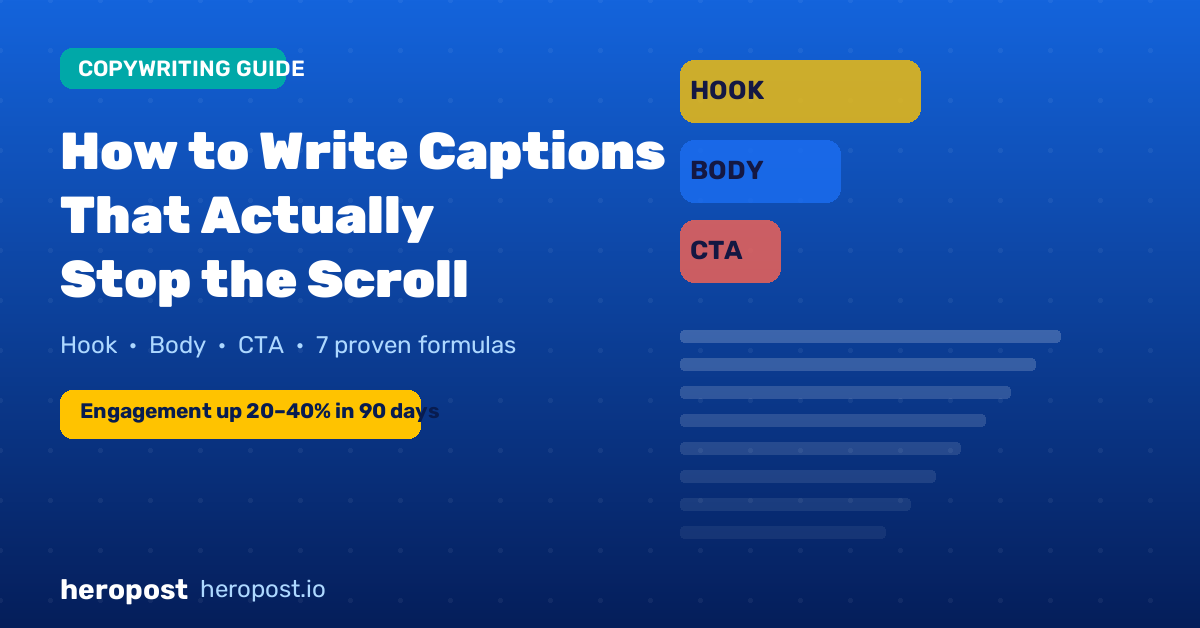
Every strong social media caption has the same basic structure:
1. Hook (first 1–2 lines)
The only part of the caption visible before the “more” click. Its job is to interrupt the scroll and compel the reader to expand. The hook should be either a bold statement, a specific question, or a teaser that creates curiosity.
2. Body (middle section)
Delivers the value promised by the hook. This can be a story, a list of tips, an explanation, a framework, or a narrative. The body should be scannable — short paragraphs, line breaks, and visual structure.
3. CTA (final line)
Tells the reader what to do next: comment with their answer, save the post for later, click the link in bio, tag a friend who needs this, or share to their story. Without a CTA, even engaged readers do not take the next step.
The 7 Highest-Performing Caption Hooks
1. The Bold Claim
Start with a statement that challenges a common belief or promises a surprising result.
“Most people have been scheduling their posts at completely the wrong time — here’s what the data actually shows.”
Works because contradiction creates cognitive friction. The reader needs to resolve it.
2. The Specific Number
Lead with a specific, concrete number that implies depth and credibility.
“After analysing 3,400 posts across 6 platforms, here’s the posting frequency that actually grows accounts in 2026.”
Works because specificity signals research and authority. Vague claims are easy to scroll past; specific claims demand attention.
3. The Relatable Problem
Open by naming a problem your audience experiences and usually does not say out loud.
“You know that feeling when you’ve spent two hours creating a post and it gets 11 likes. Here’s why — and what to do differently.”
Works because recognition is a powerful scroll-stopper.
4. The Open Loop
Begin a story or scenario and deliberately do not resolve it in the first two lines.
“Last April, I posted my worst-performing piece of content ever. It now gets me 40% of my leads. Here’s what happened.”
Works because the human brain is compelled to close open loops.
5. The Direct Question
Ask a question that requires the reader to have an opinion or that speaks directly to their goals.
“What would you do with an extra 8 hours a week? Because that’s what most creators recover when they stop posting manually.”
Works because rhetorical questions trigger active processing.
6. The Counterintuitive Insight
Lead with a statement that contradicts what the reader expects to hear.
“The more followers you have, the harder it gets to grow. Here’s why smaller accounts have a huge advantage right now.”
Works because surprise creates attention.
7. The Practical Promise
Tell the reader exactly what they will be able to do after reading this post.
“By the time you finish reading this, you’ll have a 7-day content plan you can schedule in 30 minutes.”
Works because clear value propositions justify the time investment of reading the caption fully.
Platform-Specific Caption Guidelines
Instagram
– Optimal length: 125–300 words for feed posts
– Use single line breaks frequently. Dense blocks of text perform poorly.
– 3–5 relevant hashtags at the end of the caption
– End with a direct, single-sentence CTA
LinkedIn
– Optimal length: 150–300 words for most posts; 400–700 words for thought leadership
– The algorithm truncates after 3 lines — use each of those lines to earn the click
– Professional but personal tone performs significantly better than brand-voice broadcast copy
– Ask for professional opinions or experience in the CTA
Facebook
– Optimal length: 40–80 words for high-reach posts
– Personal narrative outperforms informational posts
– End with a specific, easy-to-answer question
TikTok
– The primary hook is the first 3 seconds of video, not the caption
– Keep captions to 100–150 characters — brief, keyword-rich, and natural
– 3–5 relevant hashtags including 1–2 niche-specific ones
The Caption Writing Process
The most efficient way to write captions is in batches:
Step 1 — Write 10 hook options for each post: Do not edit while you write. Generate 10 hooks, then select the strongest one.
Step 2 — Expand the winning hook: Use the hook as the first line and build the body below it. Focus on value delivery.
Step 3 — Write 3 CTA options, then pick one: “Save this,” “Tell me in the comments,” “Tag someone who needs this,” and “Click the link in bio” all serve different conversion goals.
Step 4 — Edit for scannability: Break up any paragraph longer than 2–3 lines. Remove any sentence that does not add value or move the narrative forward.
Step 5 — Schedule in advance: Use a tool like Heropost to write, save, and schedule captions across platforms in a single workflow.
A/B Testing Your Captions
Hook A/B test: Post two similar pieces of content with different hook formats. Track comment rate and save rate specifically.
CTA A/B test: Alternate between two CTAs on similar posts over four weeks. Track which generates more saves vs. comments.
Most brands skip testing and rely on intuition. Brands that systematically test captions improve their engagement rates 20–40 percent over 90 days.
Common Caption Mistakes to Fix Immediately
The generic opening: Starting with “We are excited to announce” or “Check out our latest post” is a guaranteed scroll-trigger.
No CTA: A post without a CTA generates significantly fewer comments and clicks than an equivalent post with one.
One giant block of text: Dense paragraphs are skipped. Use line breaks aggressively.
Keyword stuffing: Unnatural keyword cramming reads as spam. Write for humans first.
CTA that asks too much: “Follow us, comment below, share with three friends, and click the link in bio” — one CTA per post.
Inconsistent tone: Your caption voice should be recognisable and consistent across all posts.
Conclusion
Captions are not decoration. They are the direct line of communication between your brand and the person who stopped scrolling for a moment to pay attention.
Master the hook, deliver genuine value in the body, and end with a clear call to action. Write in batches, test your formats, and edit for scannability. Use a scheduling tool so you are writing captions from a place of planning, not panic.
The brands building the strongest social media presence in 2026 are the ones who have learned to speak directly to the person reading — and give them a reason to stay.
Heropost makes it easier to write, schedule, and publish great captions across all your platforms — from a single content calendar. Start your free trial at heropost.io.