The most common reason people give for failing to maintain a consistent social media presence is that they do not have enough time to create content. What they usually mean is that they are trying to create entirely original content for every post on every platform. That approach is unsustainable for almost any business without a full-time content team.
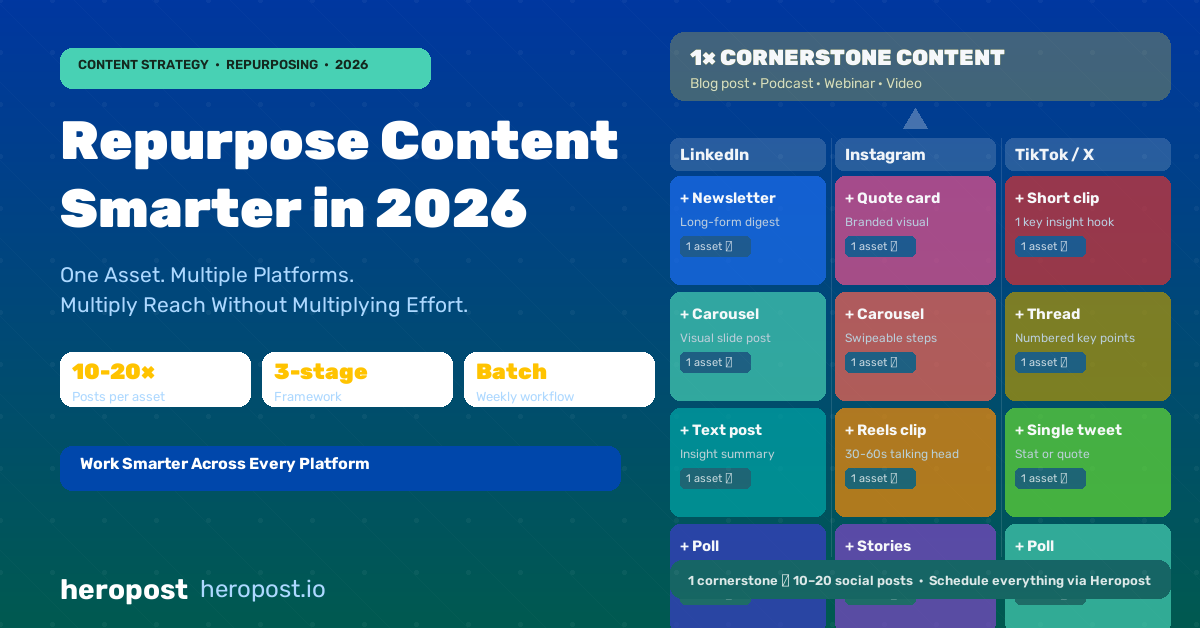
The solution is content repurposing: taking one piece of high-value content and extracting, adapting, and redistributing it across multiple formats and platforms. Done well, repurposing multiplies your output without multiplying your effort. A single piece of cornerstone content — a blog post, a podcast episode, a video — can be transformed into 10 to 20 distinct pieces of social media content.
This guide provides a systematic framework for content repurposing in 2026.
The Content Repurposing Framework
The framework works in three stages: Create the Asset, Extract the Components, Adapt and Distribute.
Stage 1: Create the Asset
Start with a substantial piece of long-form content — the cornerstone from which everything else derives. This could be:
- A long-form blog post (1,500+ words)
- A podcast episode (30+ minutes)
- A webinar or workshop recording
- A detailed case study or report
- A video tutorial (10+ minutes on YouTube)
The more substantive the original asset, the more derivative content you can extract from it. A 2,000-word blog post contains at least a dozen individual insights, statistics, frameworks, or ideas that can each become standalone social posts.
Stage 2: Extract the Components
Go through your cornerstone content and identify every discrete, valuable idea. In a blog post, this typically means:
- The core thesis or central argument
- Each major heading (usually 5-8 per post)
- Specific statistics or data points
- Quotes or expert perspectives
- Step-by-step frameworks or checklists
- Before-and-after contrasts or comparisons
- Counter-intuitive insights or myth-busting moments
Each of these is a potential piece of standalone social media content.
Stage 3: Adapt and Distribute
For each extracted component, create a platform-appropriate version. The key word is “adapt” — not simply copy-paste. Different platforms have different formats, audience expectations, and optimal lengths.
Platform-by-Platform Repurposing Tactics
From Blog Post to LinkedIn
Long-form blog posts translate naturally to LinkedIn. Options include:
- LinkedIn newsletter version (a condensed adaptation of the full post)
- Text post summarising the key insight or framework from the post
- Carousel document post turning the post’s structure into a visual slide deck (consistently the highest-engagement format on LinkedIn)
- Poll post based on a question raised in the blog
From Blog Post to Instagram
- Quote graphics: Pull memorable lines and turn them into branded quote cards
- Carousel posts: Turn the post’s numbered framework or steps into a swipe-able carousel
- Reels: Record a 30-60 second talking head video summarising the post’s core message
- Stories: Create a series of story slides linking to the full blog post
From Blog Post to TikTok/Reels
- Identify the single most interesting, counter-intuitive, or useful insight from the post
- Record a 15-30 second video with that single insight as the hook: “Most people [do wrong thing]. Here’s what actually works.”
- A single blog post can become 3-5 TikTok videos this way — each focusing on one insight
From Blog Post to Twitter/X
- Thread: Turn the post’s main points into a numbered thread (consistently high-engagement format on X)
- Single tweet: A single compelling statistic or insight from the post
- Poll: A question raised by the post’s topic
From Podcast/Video to Short-Form Clips
If your cornerstone is audio or video, the extraction process is similar but focused on clips:
- Identify 3-5 moments where a particularly clear, quotable, or surprising insight is delivered
- Extract these as short clips (30-90 seconds)
- Add captions, intro text, and branding
- Distribute across TikTok, Reels, LinkedIn, YouTube Shorts
The Content Repurposing Calendar
The most efficient way to run a repurposing strategy is to plan it in advance and batch the work:
- Week 1: Create the cornerstone content (blog post, video, or podcast)
- Week 2: Extract and create all derivative social content in one session
- Weeks 3-4: Schedule derivative content to publish across platforms over the following weeks
Using a social media scheduling tool like Heropost, you can create all your content in a single session and schedule it to publish automatically across platforms throughout the month. This approach — known as the “content batching” model — dramatically reduces the daily cognitive load of maintaining a social media presence.
What to Avoid When Repurposing
Avoid direct copy-paste across platforms. Platform cultures are distinct. A LinkedIn post pasted to Instagram without adaptation looks out of place and performs poorly. Adapt tone, length, and format for each platform.
Avoid repurposing content that is platform-specific. Twitter threads work on Twitter. They do not work on TikTok. Understand what each format is native to.
Avoid over-repurposing a single asset. Your audience may follow you across multiple platforms. If you extract 20 pieces of content from a single source, stagger their publication over several weeks so the repetition is not obvious.
Avoid stale content. Statistics and platform-specific guidance date quickly in social media. Review repurposed content to ensure it is current before publishing.
Measuring the ROI of Repurposing
Track the following metrics to evaluate your repurposing strategy:
- Content output per hour invested: How many posts are you publishing per hour of content creation time? Repurposing should dramatically improve this ratio.
- Traffic driven to cornerstone content: Are your social posts successfully driving traffic to the original blog post, video, or podcast?
- Platform-level engagement rates: Which repurposed formats are getting the most engagement on each platform? Use this to prioritise your repurposing efforts.
Conclusion
Content repurposing is not a shortcut — it is a smarter way to work. The best social media strategies are built on a foundation of high-quality cornerstone content that is systematically extracted and adapted for each platform. With the right framework and a scheduling tool to handle distribution, a single piece of well-researched content can fuel your entire social media presence for weeks. Less creating from scratch, more leveraging what you have already made.