Introduction
Accounting is a profession built on trust, expertise, and relationships. Clients stay with good accountants for decades. The challenge has always been getting those first clients in the door — and doing it efficiently.
Social media has changed the economics of professional services marketing for accountants who use it well. Instead of relying solely on referrals (which are unpredictable) or cold outreach (which is expensive and low-conversion), accountants who build a consistent social media presence create a pull marketing channel: potential clients find them through content, develop trust through consistent education, and arrive at the first conversation already convinced of their expertise.
This guide covers the full social media strategy for accountants and accounting firms in 2026.
Why Social Media Works Particularly Well for Accountants
Tax and financial questions have constant, high-volume search intent. People are perpetually searching for answers to financial and tax questions — “how do I account for home office expenses,” “what is the R&D tax credit,” “how does VAT registration work.” Creating content that answers these questions positions you as the go-to resource before people even know they need to hire an accountant.
The complexity barrier creates content opportunities. Accounting and tax law is genuinely complex. This complexity, which can feel like a barrier to content creation, is actually your advantage. You can translate complexity into clarity in a way non-professionals cannot, and that clarity is extraordinarily valuable to your audience.
Business owner audiences are highly targeted on LinkedIn. Your most valuable potential clients — small business owners, company directors, sole traders, startup founders — are concentrated on LinkedIn in a way that makes organic content an unusually efficient way to reach them.
Platform Strategy
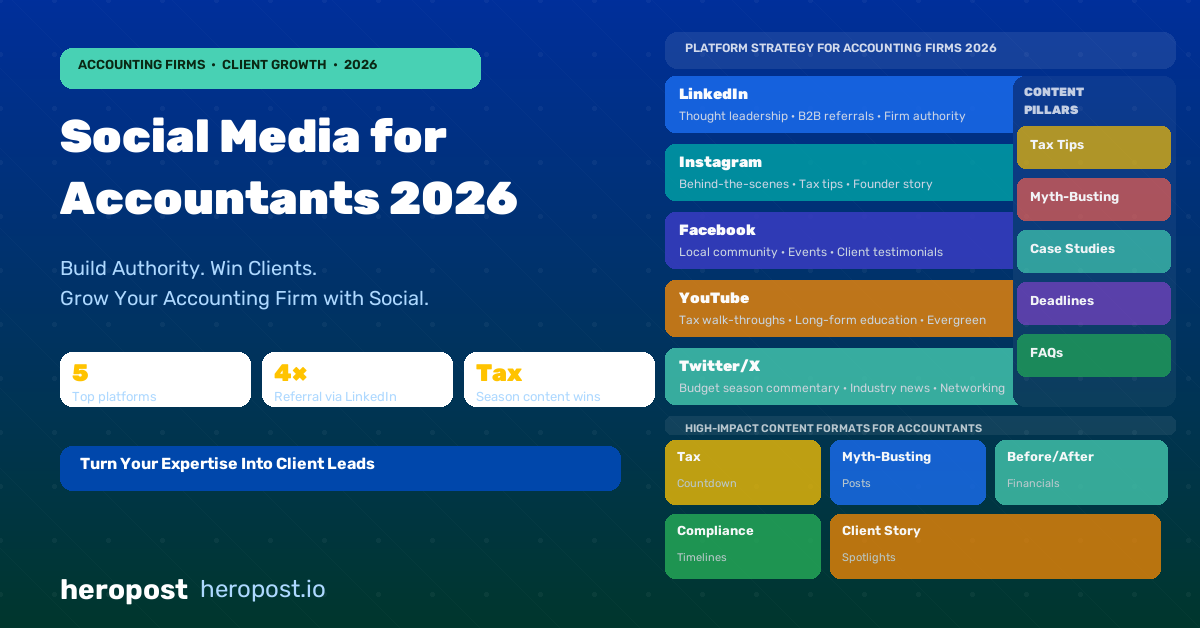
LinkedIn: The non-negotiable primary platform for most accounting practices. Your target clients — business owners, directors, self-employed professionals — use LinkedIn daily. Educational posts about tax, accounting, and financial management consistently achieve strong reach and engagement when written for a business owner audience (not an accounting audience).
Instagram: Increasingly effective for reaching self-employed individuals, sole traders, freelancers, and younger business owners. Content about money management, financial habits, and business finances in accessible formats (infographics, Reels) builds broad brand awareness.
YouTube: High-value for long-form explainer content — accountant FAQ videos, walkthrough of business year-end processes, tax deadline reminders with explanations. These have long search shelf lives and drive qualified enquiries.
Facebook: Still effective for local accounting practice marketing, community engagement, and reaching small business owner groups in your geographic area.
Content That Builds Authority for Accountants
Tax deadline reminders with educational context
The most engagement-guaranteed content any accountant can create: upcoming tax deadlines with an explanation of what they mean and what people need to do. These posts are genuinely useful, get shared widely, and demonstrate practical helpfulness — exactly the quality clients look for in an accountant.
“Do you know about [tax relief/deduction/scheme]?” posts
Highlighting tax reliefs and planning opportunities that many clients do not know about demonstrates proactive value-creation — the characteristic of the best accountants. A LinkedIn post explaining R&D tax credits, EIS/SEIS investment reliefs, or director salary strategies consistently generates saves, shares, and DMs from business owners who want to know more.
Myth-busting content
“You do not need receipts for expenses under £10” (false in many jurisdictions). “Contractors can always pay themselves through dividends” (more complicated than it sounds). Myths about tax and accounting circulate constantly in business communities. Being the authoritative voice that corrects them builds credibility.
Business lifecycle content
Different accounting questions arise at each stage of a business lifecycle: starting out (structure, VAT registration, bookkeeping setup), growing (employment costs, company structure review, tax planning), scaling (R&D, international considerations, exit planning). Content calendars built around business stages ensure relevance across a wide audience.
“Behind the numbers” stories
Share (anonymised, consented) case studies from your client work that illustrate the difference proactive accounting advice made. A business that saved £20,000 in corporation tax through proper planning. A director who avoided a penalty because their accountant flagged a deadline. These stories are both educational and compelling demonstrations of value.
LinkedIn Thought Leadership for Accountants
The accountants building the highest-profile LinkedIn presences are treating the platform the way lawyers treat professional publishing: sharing genuine expertise, developing a distinctive point of view, and becoming the person their target audience turns to for clarity on complex topics.
Practical LinkedIn tactics for accountants:
-
Post in plain English. The accountants with the largest LinkedIn followings consistently write for their clients’ level of understanding, not for other accountants. Avoid jargon. Explain acronyms. Assume the reader knows their industry but not yours.
-
Take positions. The most-shared accounting content is not neutral recitation of tax rules — it has a point of view. “Here is why I think this budget change is actually good for small businesses despite the headlines” generates more engagement than “Here is a summary of the budget.”
-
Be consistent on a niche. Accountants who focus their content on a specific client type — e-commerce businesses, creative agencies, medical practices, restaurants — build highly targeted audiences that convert at higher rates than generalist content.
-
Engage generously. Comment on posts from business owners in your target industries. Ask thoughtful questions. Share perspective. LinkedIn rewards genuine engagement and it builds network visibility faster than any other tactic.
Compliance and Professional Standards
Accounting is a regulated profession. Social media communications by accountants must adhere to professional standards, which vary by jurisdiction and professional body (ICAEW, CPA, CA, etc.).
Key universal considerations:
- All content is educational, not advice. Include clear disclaimers that content is general educational information, not specific advice for the reader’s individual circumstances.
- Fee claims and performance comparisons require careful framing to avoid professional conduct issues.
- Client data must never be referenced without explicit consent and proper anonymisation.
- Check your professional body’s guidelines on advertising and communications.
Managing Your Social Media Presence Efficiently
Accountants, particularly at smaller firms, are doing social media in addition to client work, practice management, and continuing education. The key to sustainability is batching: dedicating one or two sessions per month to creating all content for the following weeks, then scheduling it to publish automatically.
A social media management platform like Heropost allows you to create content in batch sessions and schedule posts across LinkedIn, Instagram, and other platforms from a single dashboard — keeping your presence consistent without daily attention.
Conclusion
The accountants attracting the best clients in 2026 are the ones who have made their expertise visible long before those clients had a reason to look for an accountant. Consistent, accessible, genuinely useful social media content builds the kind of trust and authority that transforms business development from an uncomfortable cold-outreach activity into a pull marketing engine that works while you focus on client work.