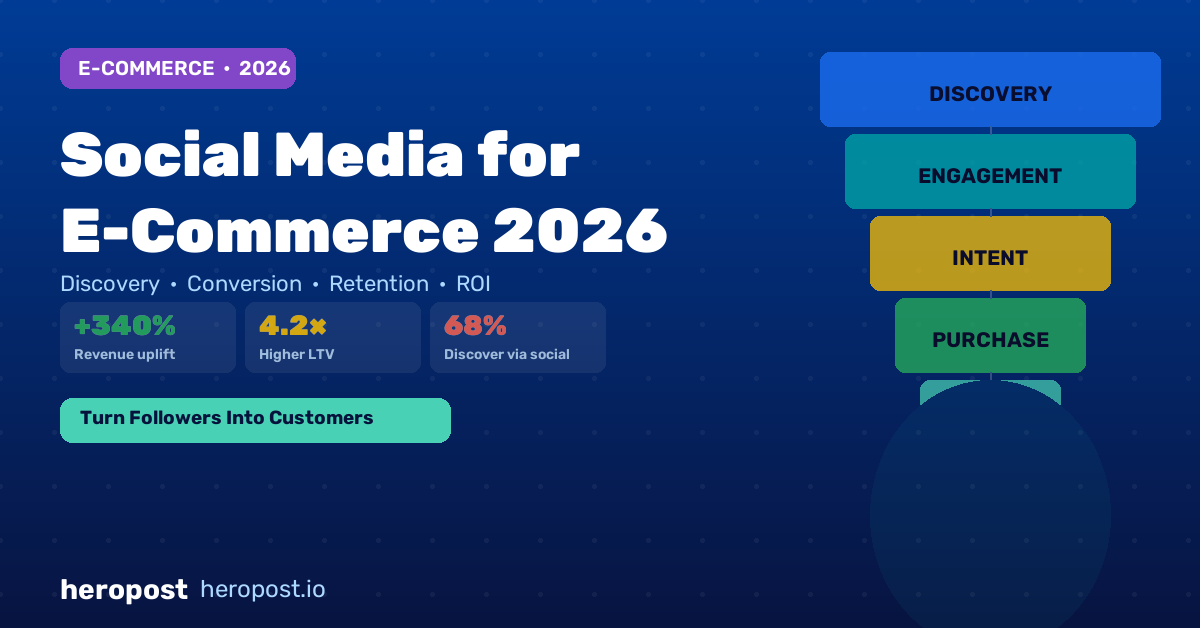
E-commerce brands have the clearest line between social media and revenue of any business category. Product discovery on Instagram. Purchase via TikTok Shop. Customer service in Facebook DMs. Review sharing in Stories. The entire customer journey — from awareness to post-purchase advocacy — now runs through social platforms.
The brands winning on social media in 2026 are not simply the ones with the biggest ad budgets. They are the ones that understand social commerce, build genuine community, and create content that converts at every stage of the funnel.
This playbook covers everything e-commerce brands need to implement a social media strategy that drives real revenue.
The E-Commerce Social Media Landscape in 2026
Three significant shifts define the current environment:
Social commerce has matured. TikTok Shop, Instagram Shopping, and Pinterest’s shoppable pins have evolved from novelty features into genuine revenue channels. Brands that have optimised for native in-app purchase now see measurable revenue directly attributed to social platforms, not just assisted conversions.
UGC and creator content outperforms brand content. Consumers trust content from real people more than brand-produced creative. E-commerce brands investing in creator partnerships — even micro-influencers with highly engaged niche audiences — consistently outperform those relying on studio-produced content.
Community is the retention engine. Customer acquisition costs have risen across all paid channels. The e-commerce brands with the strongest retention rates have built genuine social media communities — Facebook Groups, Discord servers, Instagram follower communities — that keep customers engaged between purchases.
Platform Strategy for E-Commerce
Instagram — The Product Discovery Platform
Instagram remains the primary discovery platform for physical products, particularly in fashion, beauty, home, and lifestyle categories.
E-commerce Instagram strategy:
- Product-in-context photography: Show products being used, worn, or displayed in real environments — not just white-background studio shots. Lifestyle photography consistently outperforms catalogue-style imagery in engagement and conversion.
- Instagram Shopping integration: Tag products in every relevant post and Reel. Shopping-enabled content gives users a direct path from discovery to purchase without leaving the app.
- Reels for product demonstration: A 30-second Reel showing how a product works, what it looks like in motion, or how it is used drives significantly higher click-through than static imagery.
- Stories for flash sales and limited editions: The urgency mechanics of Stories (24-hour disappearance) align perfectly with limited-time offers and stock alerts.
- User-generated content strategy: Create a branded hashtag. Feature customer photos. Run competitions that encourage customers to post with your products. UGC generates social proof at zero cost.
TikTok — The Viral Product Launch Platform
TikTok is where products become cultural moments. A single organic TikTok that captures the right audience at the right time can drive more sales in 48 hours than months of conventional advertising.
TikTok e-commerce tactics:
- TikTok Shop integration: List your products in TikTok Shop and tag them in content. Native checkout removes friction from the discovery-to-purchase journey.
- Authentic unboxing content: First-person unboxing videos from real customers (or founders) consistently generate high engagement and trust.
- “Why I switched to [product]” format: Honest comparison content from a satisfied customer perspective performs exceptionally well in the beauty, supplement, and home goods categories.
- Creator partnerships: TikTok’s Creator Marketplace connects brands with creators in specific niches. A creator with 50,000 highly engaged followers in your target niche will outperform a celebrity with 5 million passive followers.
- TikTok Live Shopping: Live product demonstrations with direct purchase links during the stream. This format is growing significantly and converts at rates comparable to home shopping television.
Pinterest — The High-Intent Purchase Platform
Pinterest users have purchasing intent. They are actively looking for products, ideas, and inspiration — and they are willing to buy. Pinterest drives more revenue per click than most other social platforms for categories including home décor, fashion, food, and gifts.
Pinterest e-commerce strategy:
- Rich Pins: Enable Product Rich Pins to automatically sync pricing and availability from your product catalogue. These update in real time and include a direct shop button.
- SEO-optimised descriptions: Pinterest functions as a search engine. Write pin descriptions with keywords your customers actually search for.
- Boards organised by customer intent: “Living Room Inspiration,” “Gifts Under £30,” “Summer Outfits 2026” — organise boards around how customers think, not how you categorise your products.
- Consistent pinning: Pinterest rewards accounts that pin regularly. 5-10 pins per day is optimal; use a scheduling tool like Heropost to maintain this cadence without manual effort.
Facebook — For Community and Remarketing
Facebook’s organic reach for brand pages is limited, but it remains powerful for two specific use cases:
- Facebook Groups: Create a community group around your product category (not just your brand). A home organisation brand’s “Organised Home Community” group that genuinely helps members creates loyalty that translates to purchase behaviour.
- Facebook Ads for remarketing: Retargeting website visitors and cart abandoners via Facebook Ads remains one of the highest-ROI paid channels for e-commerce. Your social media organic efforts build the audience; Facebook Ads converts them.
Content Strategy for E-Commerce Brands
The Five Content Types That Drive E-Commerce Results
1. Product demonstration content
Show the product in action. How does it work? What problem does it solve? What does it look like in real life versus the product page? Video is the most effective format here.
2. Social proof and reviews
Feature customer reviews, before-and-after results, star ratings, and testimonials. Make social proof a consistent content pillar, not an occasional post. The most trusted content is from customers who look like your target audience.
3. Behind-the-brand content
Who makes your products? Where do the materials come from? What is the story behind the brand? This content builds the emotional connection that turns one-time buyers into loyal customers.
4. Educational content
How to use the product, how to style it, how to maintain it, how to get maximum value from it. Educational content keeps existing customers engaged and helps prospects overcome purchase hesitation.
5. Promotional content
Sales, limited editions, restocks, and new launches. Keep promotional content to approximately 20% of your calendar. Constant promotional posting trains your audience to wait for discounts rather than buying at full price.
Social Commerce Optimisation
Social commerce — purchasing directly through social platforms without leaving the app — is the fastest-growing e-commerce channel in 2026.
Instagram Shopping setup:
- Connect your product catalogue to your Meta Business Manager account
- Enable Instagram Shopping in your account settings
- Tag products in posts, Reels, and Stories
- Set up an Instagram Shop tab on your profile
- Monitor Instagram Shopping analytics for top-performing products
TikTok Shop setup:
- Register as a TikTok Shop seller
- Upload your product catalogue
- Link products in organic content
- Partner with creators through the Affiliate Programme — they earn commission on sales they drive
- Run TikTok Ads with direct product links
The checkout friction imperative: Every additional tap between discovery and purchase costs you conversions. Optimise for native checkout wherever possible. If native checkout is not available, ensure your mobile site loads in under 2 seconds and your checkout is genuinely mobile-optimised.
Creator and Influencer Partnerships for E-Commerce
The influencer model has matured significantly. The most effective e-commerce brands no longer approach influencer marketing as a broadcast channel — they build genuine creator partnerships with performance-based structures.
Micro-influencers outperform macro-influencers for most e-commerce categories. A creator with 10,000 genuinely engaged followers in a niche directly relevant to your product will drive more sales at lower cost than a celebrity with 2 million disengaged followers.
Performance-based structures:
- Affiliate links and codes — creators earn commission on sales they drive (trackable via unique discount codes or affiliate links)
- Revenue sharing — more complex but aligns creator incentives directly with your outcomes
- Hybrid: flat fee + affiliate — provides baseline security for the creator while maintaining performance upside for the brand
Gifting with no strings attached: Sending products to relevant creators without expectation of coverage, then following up warmly, often generates authentic posts that convert better than paid partnerships. Authentic enthusiasm is the most powerful sales driver on social media.
Long-term creator relationships: Brands that work with the same creators over multiple campaigns see compounding trust effects. An audience that has seen a creator genuinely use a product over six months trusts their recommendation far more than a single sponsored post.
Measuring E-Commerce Social Media Performance
The metrics that matter for e-commerce brands:
Awareness layer: Reach, impressions, follower growth — is your audience growing?
Engagement layer: Engagement rate, saves, shares — is your content resonating?
Traffic layer: Social referral sessions (Google Analytics), add-to-cart rate from social traffic — are followers visiting and showing purchase intent?
Revenue layer: Social-attributed revenue (via UTM tracking), revenue from TikTok Shop / Instagram Shopping, revenue from affiliate creator codes
Retention layer: Repeat purchase rate among customers acquired through social, community engagement metrics (Group activity, comment sentiment)
Review these monthly. The brands that win at social commerce are those that treat it as a data-driven discipline, not a creative outlet.
Conclusion
Social media for e-commerce in 2026 is not optional — it is where your customers discover products, evaluate brands, get social proof, and increasingly complete purchases without ever leaving the platform.
The brands that win are those that build genuine community around their products, invest in creator partnerships with performance accountability, and treat social commerce as a first-class revenue channel rather than a traffic driver to their website.
Start with the platforms where your customers actually spend time. Build the content machine. Optimise for native commerce. Measure what matters.
Heropost helps e-commerce brands manage their social media pipeline — schedule content across Instagram, TikTok, Pinterest, and Facebook, track performance, and coordinate creator content from one dashboard. Start your free trial at heropost.io.