Introduction
Financial services is one of the most trust-dependent industries in the world. Clients are handing over their life savings, retirement security, and financial futures to professionals they need to believe in completely. That level of trust has traditionally been built slowly, through referrals and in-person relationships.
Social media changes the timeline. Financial advisors who consistently share accessible, accurate, genuinely useful financial education online build trust at scale — reaching potential clients they would never have encountered through referrals, and doing it before those clients even know they need financial advice.
The advisors building the most efficient client pipelines in 2026 are doing it through consistent, compliant, education-first social media content. This guide shows you how.
The Compliance Landscape
Before diving into strategy, compliance must be addressed. Financial services social media operates under regulatory scrutiny that does not apply to most other industries.
In the US, FINRA and SEC rules govern what financial professionals can say in social media communications. In the UK, the FCA governs financial promotions. Similar frameworks exist across most jurisdictions. Key principles that apply near-universally:
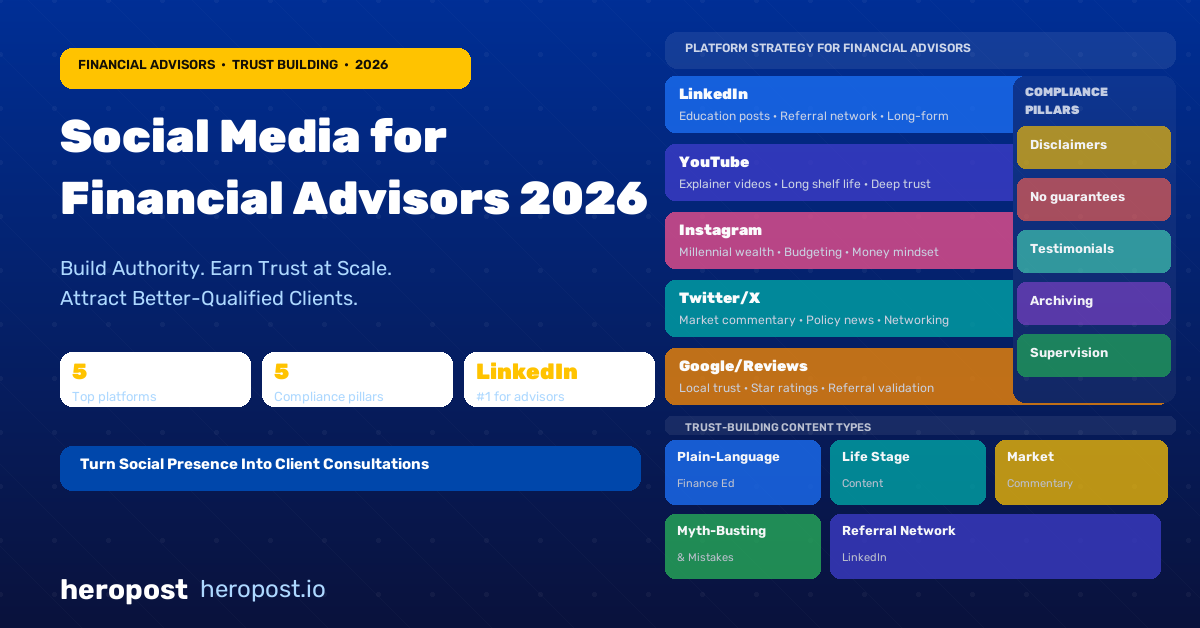
Suitability disclaimers: Educational content must be clearly distinguished from personalised advice. Standard disclaimers (“This is general educational content and does not constitute personal financial advice”) should accompany all educational posts.
No performance guarantees: Claims about investment returns, even historical ones, require careful compliance review. Avoid implied promises about future performance.
Testimonials and endorsements: In many jurisdictions, client testimonials for financial advisors are regulated or prohibited. Check your specific regulatory requirements before soliciting or publishing client testimonials.
Record-keeping: Most financial services regulations require that social media communications be archived. Ensure your firm’s compliance infrastructure captures social media posts and DMs.
Supervision and approval: Many firms require compliance approval for social media content before posting. Build approval workflows into your content calendar.
Platform Strategy for Financial Advisors
LinkedIn: The primary platform for most financial advisors. Your prospects — whether individual high-net-worth clients, business owners, or institutional investors — are on LinkedIn. Educational posts about personal finance, investment principles, tax strategy, and retirement planning consistently perform well and reach exactly the right audience.
YouTube: High-value for advisors willing to invest in long-form video. Financial education content on YouTube has an unusually long shelf life — a well-made explainer video about compound interest or tax-advantaged accounts can drive qualified leads for years.
Instagram: Works well for advisors targeting younger demographics (millennials building their first significant wealth), lifestyle-oriented wealth clients, or consumer-facing financial education. Visual content about money mindset, budgeting, and financial habits performs particularly well.
Twitter/X: Relevant for advisors with opinions on markets, policy, and economic events. Commentary on news — positioned thoughtfully and compliantly — builds visibility in financial professional networks.
Content That Builds Trust in Financial Services
Plain-language financial education
Most people find personal finance confusing and intimidating. The advisor who consistently translates complex financial concepts into clear, accessible language becomes the trusted voice their audience turns to when they need professional help. Content ideas:
- “How compound interest actually works (with real numbers)”
- “What to do with a windfall: a framework for making good decisions quickly”
- “The difference between a financial planner and a financial advisor”
- “5 questions to ask before hiring a financial advisor”
Life stage content
Different clients face different financial challenges at different points in their lives. Creating content calendars around life stages — starting a first job, buying a home, having children, approaching retirement, inheriting wealth — allows you to be present with relevant, useful content at each decision point.
Market commentary (carefully)
Timely commentary on market events, economic data, or financial news demonstrates current relevance and expertise. The key is being genuinely informative rather than alarmist or promotional. “Here is what this week’s inflation data means for your fixed income allocation” is educational. “Buy gold now before it is too late” is compliance risk.
Myth-busting and mistake-prevention
The financial internet is full of bad advice. Content that addresses common mistakes (“Why paying off your mortgage early is not always the right choice”) or debunks financial myths (“Why you do not need to be rich to benefit from a financial advisor”) builds authority and often attracts shares from grateful readers.
Building a Referral Network Through LinkedIn
The highest-ROI use of LinkedIn for financial advisors is not individual client acquisition — it is referral network development. Building relationships with accountants, solicitors, mortgage brokers, HR managers, and other professionals who regularly encounter clients who need financial advice creates a compounding referral engine.
Tactics for referral network building on LinkedIn:
- Connect with and engage with content from professionals in complementary fields
- Share content that is useful to your referral partners, not just your target clients
- Comment substantively on the posts of professionals in your network
- Introduce connections to each other when relevant — this generates reciprocity
- Post about cross-disciplinary collaborations when appropriate
Managing Compliance and Volume with the Right Tools
For financial advisors at firms with compliance approval workflows, creating content, getting it approved, and publishing it consistently is a significant operational challenge. Social media management platforms that support approval workflows, content calendars, and multi-platform scheduling — like Heropost — dramatically reduce the overhead of compliant social media management.
Conclusion
The financial advisors who are building the most efficient, high-quality client pipelines in 2026 are not the ones spending the most on LinkedIn advertising or buying lead lists. They are the ones who have spent months demonstrating, consistently and publicly, that they understand personal finance deeply and care about the financial wellbeing of the people they serve. That reputation, built in public over time, is more valuable than any lead generation campaign — and infinitely harder for competitors to replicate.