Introduction
Interior design is one of the most naturally social-media-friendly professions that exists. The work is visual. The transformation is dramatic. The process is fascinating. And the clients — people remodelling homes, developers specifying commercial spaces, hospitality brands creating environments — are active on the exact platforms where design thrives.
Yet many interior designers underutilise their social media presence, treating it as a passive gallery rather than an active client acquisition channel. The designers building thriving studio practices through social media in 2026 are doing something different: they are making their process visible, building genuine audience relationships, and turning beautiful images into booked projects.
Platform Strategy for Interior Designers
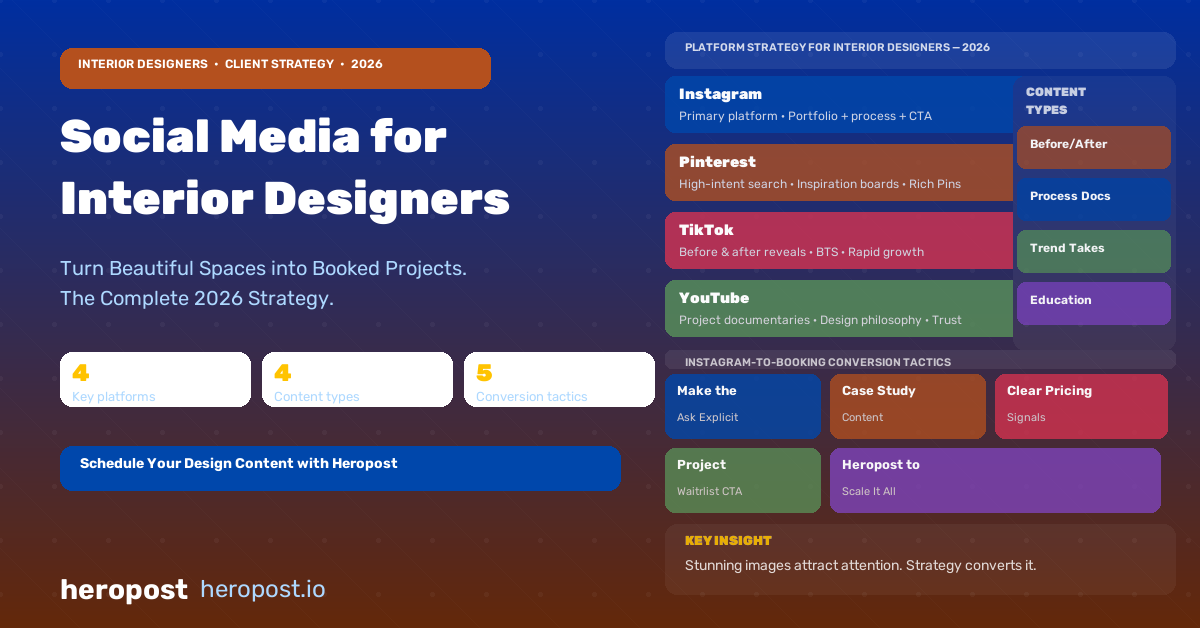
Instagram: Still the primary platform for interior design. Instagram’s visual feed is purpose-built for the kind of transformative, aspirational imagery that interior design produces. Your portfolio lives here, your audience follows you here, and your ideal clients discover you here.
Pinterest: Potentially as important as Instagram for interior designers, because Pinterest is where design decisions are actively made. Homeowners building “inspiration boards” for their renovations are on Pinterest. Developers researching design directions are on Pinterest. A well-optimised Pinterest presence puts your work in front of people at the exact moment of purchase intent — when they are actively planning a project.
TikTok: Growing significantly for interior designers, particularly with transformation content (“before and after” reveals), process documentation, and design education content. TikTok can achieve the kind of rapid audience growth that Instagram has made increasingly difficult, and the design niche is still relatively undersaturated on the platform.
YouTube: Ideal for longer-form project documentaries, design philosophy content, and detailed before-and-after walkthroughs. These have a long shelf life and build the kind of deep trust that supports high-value client relationships.
Instagram Strategy for Interior Designers
The portfolio approach is necessary but not sufficient. Stunning finished-space photography should form the foundation of your Instagram presence, but it alone will not differentiate you from the hundreds of other designers posting stunning imagery. What differentiates is the layer above the portfolio: your process, your perspective, your personality.
Post types that perform for interior designers:
Before and after posts: Consistently the highest-performing format for interior designers. The transformation reveal satisfies a deep human desire for resolution and improvement. The key is showing enough of the “before” to make the “after” genuinely impressive — a single poorly lit “before” photo paired with a professional “after” dramatically underpowers the comparison. Document the before properly.
Process documentation: The mood board, the material samples, the drawing, the site visit, the installation day chaos. These posts humanise the work, build understanding of your process, and generate the highest comment engagement of any content type. People want to see how the sausage is made.
Design education content: “Why I chose this sofa scale for this room,” “the rule of thirds in room composition,” “how to mix patterns without clashing.” Educational posts position you as an authority and serve an audience far wider than your current client base — building awareness with people who are years away from being able to hire you, but who remember your name when they are ready.
Your perspective on design trends: Share your genuine opinion on what is coming, what is going, and what is timeless. Clients hire designers not just for their taste but for their judgment. Demonstrating that judgment publicly builds the confidence that precedes a booking enquiry.
Pinterest for Interior Designers: A Systematic Approach
Pinterest requires a different mindset than Instagram. Where Instagram is about building an audience and a following, Pinterest is about being discovered by people who are actively searching.
Keyword-optimise everything. Your board names, board descriptions, pin titles, and pin descriptions should all include the specific search terms your ideal clients use: “living room interior design ideas,” “Scandinavian home office design,” “luxury bathroom renovation.” Pinterest is a search engine. Treat it like one.
Create boards that mirror your clients’ planning process. Not just “My Projects” but “Living Room Inspiration,” “Kitchen Design Ideas,” “Home Office Design,” “Before and After Transformations.” These board themes match the way clients are searching and planning.
Pin consistently, not just when you have new projects. Pin other designers’ work (that complements your style), editorial content from design publications, product imagery from suppliers you love. Boards that mix your work with curated content build more valuable, more-followed collections.
Rich Pins for your portfolio: Connect your website to Pinterest and enable Rich Pins — they pull through additional information from your pages and perform better algorithmically.
Converting Social Media Followers to Project Enquiries
The gap between “beautiful Instagram” and “full studio calendar” is a conversion problem. The most common fix:
Make the ask explicit. Many designers feel uncomfortable directly inviting enquiries. But audiences need prompts. “I have availability for projects beginning in [season],” “if you are planning a [type of project] in [location], let us talk,” and “DM me or click the link in bio to explore working together” are simple, effective, and necessary.
Case studies that speak to the decision moment. The most conversion-effective content for high-value services is detailed case study content — telling the full story of a specific project from brief to completion, including the client’s initial challenge, the design thinking applied, and the outcome. These posts attract clients who recognise their own situation in the story.
Clear pricing signals. You do not have to list fees, but giving a sense of investment level (through language or a starting fee) pre-qualifies enquiries and attracts clients who are ready to invest appropriately.
Conclusion
The interior designers building the most successful studios through social media are not doing anything mysterious. They are posting consistently, showing process alongside portfolio, building genuine audience relationships through educational content, and making clear and confident invitations to work together. The stunning images attract attention. The strategy converts it.