The legal profession has been slow to embrace social media — and understandably so. Lawyers operate under strict professional conduct rules, and the risks of getting it wrong feel significant. But the firms that have invested in building a credible, educational social media presence are seeing something that changes the economics of legal marketing fundamentally: clients arrive already trusting them.
Traditional legal marketing works by interruption — an advertisement that says “we exist, call us.” Social media marketing works by attraction — consistently demonstrating legal knowledge and genuine care for the people you serve, so that when someone needs legal help, you are the first person they think of and the first person they trust.
Why Social Media Works for Legal Services
The trust problem in legal services: Hiring a lawyer is one of the highest-stakes professional relationships a person enters. Social media reduces the barrier to engagement before the first contact is made. When a potential client has been reading your posts on employment law for six months, they arrive at their first consultation feeling like they already know you.
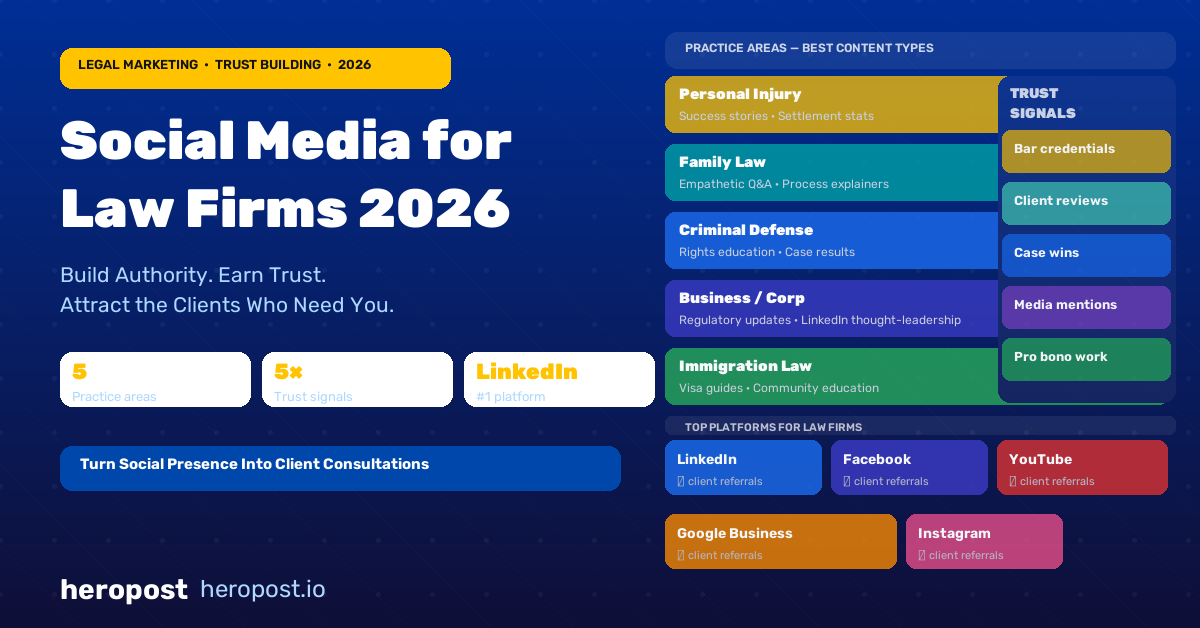
Referrals happen on LinkedIn: Most law firm clients still come through referrals. In 2026, LinkedIn is where professional referrals happen. Being visible, active, and demonstrably competent on LinkedIn means you are present in the network where people are asking “do you know a good lawyer who handles [X]?”
Search-intent content drives qualified leads: People facing legal issues search for information before they search for lawyers. Creating content that answers these questions puts you in front of the exact people who will shortly need legal representation.
Choosing Your Platforms
LinkedIn: The primary platform for most lawyers and law firms. Professional audience, credibility-building content, and referral network make it indispensable for the vast majority of legal practices.
YouTube: High-value for law firms willing to invest in video. “Know Your Rights” style educational videos build significant organic authority. Viewers convert to enquiries at high rates because video builds personal familiarity.
Instagram: Works well for family law, immigration law, and other practice areas with a consumer-facing, emotionally resonant dimension.
TikTok: Growing in relevance for consumer-facing law — personal injury, employment law, family law, immigration — particularly for younger demographics.
Twitter/X: Still relevant for legal commentary and thought leadership, particularly in commercial law, technology law, regulatory areas, and policy-adjacent practice.
Content That Works for Lawyers
Plain-language legal explainers
The single most effective content category for lawyers. Take a common legal question or misconception and explain it clearly, in plain English. Examples by practice area:
- Employment law: “5 things employers cannot legally include in a settlement agreement”
- Family law: “How courts actually calculate child support — the factors you need to know”
- Personal injury: “What happens at each stage of a personal injury claim”
- Commercial law: “The contract clause most businesses overlook (and why it matters)”
Case study content (properly anonymised)
With appropriate anonymisation and client consent, case studies are compelling content. Narrative stories that explain the legal challenge, the strategy, and the outcome demonstrate capability and build credibility.
Commentary on legal developments
When legislation changes, court decisions are handed down, or regulatory developments occur in your practice area, be the first and clearest voice explaining what it means. Legal commentary during breaking developments earns shares, quotes, and media enquiries.
Behind-the-scenes and culture content
Show who your people are, how the firm operates, and what it is like to work there. Authenticity in culture content attracts both talent and clients who want to work with human beings, not institutions.
Compliance Considerations
Every jurisdiction has professional conduct rules governing lawyer advertising and communications. Universal principles include:
No client confidentiality breaches: Never publish any information that could identify a client without explicit written consent.
Accurate and not misleading: Avoid superlatives (“best lawyer in the city”), unsubstantiated claims, or anything that could mislead potential clients about the likely outcomes of legal matters.
Clear disclaimers on general information: Each piece of educational content should include a brief, clear disclaimer stating that it is general information only and not a substitute for legal advice specific to individual circumstances.
Jurisdiction-specific rules: Some bars prohibit certain types of testimonials, referral incentives, or specific advertising claims. Check your local rules before posting.
Building Thought Leadership on LinkedIn
LinkedIn thought leadership is the highest-value social media investment for most lawyers. The approach that works:
- Post frequently and consistently. Daily or near-daily posting significantly outperforms weekly posting on LinkedIn.
- Write in plain English. The lawyers who build the largest LinkedIn audiences consistently translate legal complexity into accessible language.
- Engage genuinely. Comment substantively on posts from other professionals in your network.
- Share your perspective. The most-shared legal content on LinkedIn has a point of view. Express opinions thoughtfully.
Scheduling and Managing Your Social Media Presence
Consistent posting across LinkedIn, Instagram, and any other platforms is a significant ongoing commitment for busy lawyers. Batching content creation and scheduling through a platform like Heropost lets you dedicate a single session each week to content creation and scheduling, then publish automatically throughout the period without daily attention.
Conclusion
The lawyers building the most trusted and profitable practices on social media are doing it the same way lawyers have always built practices — by demonstrating deep knowledge, genuine care for the people they serve, and consistent professional integrity. Social media simply gives those qualities a wider audience and a compounding platform. The investment is modest relative to the return: a stream of clients who arrive pre-qualified, pre-trusting, and ready to engage.