Introduction
Personal training has always been a referral business. A happy client tells two friends. In 2026, those two friends tell two hundred followers — and a personal trainer with a strong social media presence turns every satisfied client into a marketing channel.
The trainers building full schedules and waiting lists today are not necessarily the most qualified in their area. They are the ones who have learned to demonstrate their expertise, their personality, and their results online — consistently and authentically.
This guide is the complete social media playbook for personal trainers: which platforms to focus on, what to post, how to convert followers into clients, and the specific tactics that work for fitness professionals.
Why Social Media Is Now Essential for Personal Trainers
Three shifts have made social media non-negotiable for personal trainers in 2026:
The discovery journey starts online. When someone decides they want a personal trainer, the first thing they do is search Instagram, TikTok, or Google. A trainer with no social presence — or a dormant one — is functionally invisible to a large portion of prospective clients.
Social proof drives buying decisions. Prospective clients want to see evidence that you get results. Transformation photos, client testimonials, and before-and-after content are the most powerful sales tools a personal trainer has — and social media is where they live.
Geographic barriers are falling. Online training has matured significantly. Personal trainers who build strong social media followings can serve clients globally, not just those within driving distance of their gym.
Platform Strategy for Personal Trainers
Instagram — The Primary Platform
Instagram remains the most important social platform for personal trainers. The combination of photos, Reels, and Stories allows you to showcase results, demonstrate knowledge, and build personal connection simultaneously.
What works on Instagram for trainers:
Transformation content: Before-and-after photos (always with client permission) are the most powerful content a personal trainer can post. They provide concrete proof of results and answer the prospect’s primary question: “Can this trainer actually get me to where I want to go?”
Educational Reels: Short videos demonstrating exercises, explaining technique, and busting fitness myths perform exceptionally well. You are showcasing expertise while providing genuine value — the dual function that builds both trust and followers.
Workout clips and form guidance: Exercise demonstration videos serve multiple purposes: they attract prospects searching for specific exercises, they position you as knowledgeable, and they show existing clients what training with you looks like.
Day-in-the-life content: Stories and Reels showing your training day, your own workouts, meal prep, early morning sessions — this humanises you and shows the reality of working with a professional trainer.
Client spotlights: Feature your clients’ progress and stories (with permission). This celebrates their achievement, provides social proof, and makes them feel valued — which generates referrals.
TikTok — The Reach Engine
TikTok has become one of the most powerful client acquisition channels for personal trainers under 45. The algorithm gives new accounts a genuine chance at organic reach, and fitness content performs exceptionally well on the platform.
TikTok content that works for trainers:
- Quick exercise demos with technique tips (15-30 seconds)
- “Fitness myths debunked” series
- “What I eat in a day as a personal trainer”
- “Things I wish I knew before starting the gym”
- Client progress clips (with permission and enthusiastic support)
- Honest answers to common questions: “How long to see results?” “Do I need to count calories?”
TikTok’s younger demographic is becoming increasingly valuable as millennial and Gen Z earners enter peak fitness spending years.
YouTube — For the Long Game
YouTube is underused by most personal trainers and consistently rewarding for those who commit to it. Full-length workout videos, training series, and in-depth educational content rank in search and generate leads for years after publication.
The barrier is consistency — a weekly upload schedule for 6+ months before seeing significant results. The trainers who have built YouTube channels over 2-3 years consistently report it as their highest-quality lead source.
Content Strategy: What to Post and Why
The Five Content Pillars for Personal Trainers
1. Results and Social Proof
Your clients’ results are your most powerful content. Share transformations, milestones (first pull-up, new personal best, completing a challenge), and testimonials. Tag clients when they are comfortable with it.
2. Exercise Education
Teach your audience how to train effectively and safely. Form guides, exercise alternatives, mobility work, beginner-friendly progressions — educational content demonstrates expertise and serves both prospects and existing clients.
3. Nutrition Guidance
Fitness results are 50-60% nutrition for most clients. Sharing basic, actionable nutrition guidance (without crossing into clinical dietitian territory) is highly searched content that attracts your ideal audience.
4. Trainer Personality and Values
Why do you train? What drives you? What do you believe about fitness that others get wrong? The trainers with the most loyal audiences share genuine opinions and personal stories, not just professional advice.
5. Behind the Scenes
Your own training, your morning routine, what your gym looks like, how you programme for clients — behind-the-scenes content builds connection and shows professionalism simultaneously.
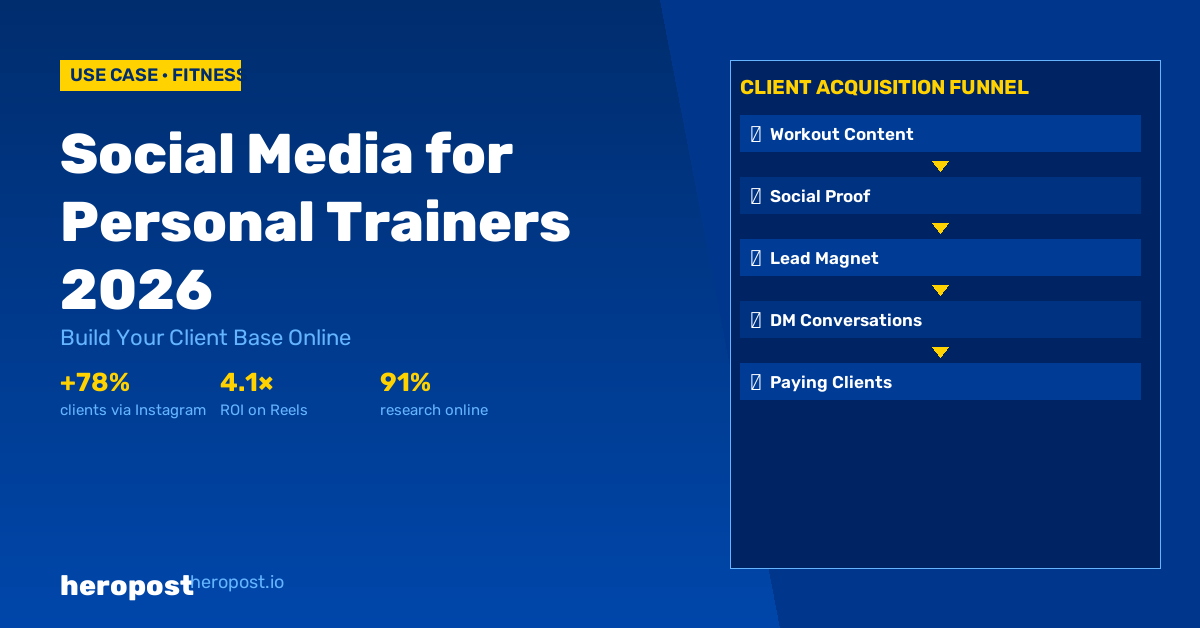
Client Acquisition: Converting Followers Into Paying Clients
Building a following is the foundation. Converting that following into a client pipeline requires deliberate strategy.
Clear bio and call to action:
Your Instagram bio should state exactly what you do, who you help, and how to get started. “Online and in-person PT | London | Helping busy professionals get stronger without living in the gym” with a link to your enquiry form converts significantly better than a vague bio.
Regular availability posts:
Post your availability openly and regularly. “Taking 3 new online clients in May — DM me if interested” combined with a compelling piece of content creates natural conversion opportunities.
Free lead magnet:
Offer a free training plan, workout guide, or nutrition overview in exchange for an email address. Promote it regularly on Stories and posts. This builds your email list alongside your social following and creates a nurture sequence for prospects not yet ready to book.
Consultation offer:
Offer a free 20-minute consultation call for serious enquiries. This low-barrier entry point converts social followers into real conversations — and real conversations convert into clients at high rates.
DM response speed:
When someone DMs to enquire, respond within hours. Most trainer enquiries go to 2-3 trainers simultaneously. The first to respond with warmth and professionalism usually gets the booking.
Building a Niche: Why Specific Beats General
The most financially successful personal trainers on social media are not generalists — they are specialists. A trainer who serves “busy mums who want to lose weight after having children” will attract those clients far more effectively than a trainer who serves “everyone who wants to get fit.”
Specialisation makes your content more resonant (it speaks directly to one person’s situation), makes your marketing more efficient (you know exactly where to find your audience), and justifies premium pricing (specialists command higher rates than generalists).
Your niche can be:
– Demographic: New mums, men over 40, teenagers, seniors
– Goal-based: Marathon preparation, powerlifting, fat loss, posture correction
– Condition-based: Pre/postnatal, back pain, diabetes management (requires additional qualifications)
– Lifestyle-based: Shift workers, busy executives, remote workers
Once you have a niche, your content becomes laser-targeted — and the right people find you far more efficiently.
Online Training: Scaling Beyond Local Geography
Social media makes online training viable for personal trainers at every stage of their career. If you are not offering online training in 2026, you are limiting your income to the number of in-person hours you can physically deliver.
Online training enables:
– Serving clients anywhere in the world
– Recurring revenue from programme subscriptions
– Higher volume at lower time cost than 1:1 in-person sessions
– Passive income from pre-built programmes sold as digital products
Use your social media presence to showcase online training specifically. “I work with clients in 12 countries” is a compelling credibility signal. Testimonials from online clients in different locations expand your perceived reach.
Conclusion
Personal trainers who show up consistently on social media in 2026 — sharing real results, genuine expertise, and authentic personality — build the kind of trust that fills schedules without cold outreach or advertising spend.
The formula is straightforward: demonstrate results, share knowledge, be a real person. Repeat consistently over months and years.
Heropost helps personal trainers manage their social media pipeline — schedule posts across Instagram and TikTok, batch your content creation, and keep your online presence consistent even during your busiest training weeks. Start your free trial at heropost.io.