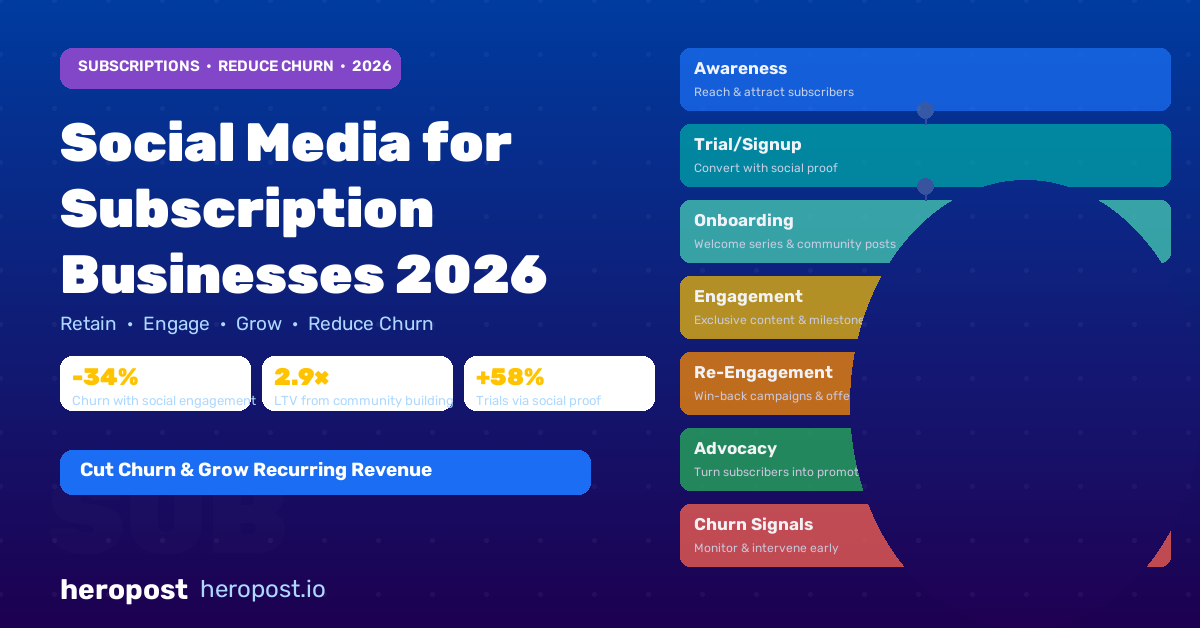
Subscription businesses — SaaS companies, subscription boxes, membership communities, streaming services, and recurring service providers — have a different relationship with social media than transactional businesses.
For a one-time sale, social media’s job is acquisition: bring in a customer, complete the transaction, done. For a subscription business, the job never ends. Every month, the customer makes an implicit re-purchase decision. Social media must serve both acquisition (bringing in new subscribers) and retention (keeping existing ones engaged, successful, and loyal).
This dual mandate changes how subscription businesses should approach social media strategy. This guide covers both jobs: the acquisition funnel and the retention engine.
The Subscription Social Media Dual Mandate
Acquisition: Reaching prospective subscribers who do not yet know your product, showing them what problem it solves and why it is worth paying for monthly, and converting interest into a trial or sign-up.
Retention: Keeping existing subscribers engaged with the product, celebrating their successes, building community among users, and reinforcing the ongoing value that justifies the recurring charge.
Most subscription businesses focus almost exclusively on acquisition in their social media strategy — and then wonder why churn is high despite strong top-of-funnel numbers. The companies with the best net revenue retention are the ones investing equally in both halves.
Acquisition-Focused Social Media Strategy
Platform Selection for Subscriber Acquisition
The right acquisition platforms depend on your target audience and price point:
- Low-price consumer subscriptions (under £30/month): TikTok and Instagram are the primary acquisition channels. Content needs to communicate the value proposition immediately and make sign-up feel low-risk.
- Mid-market B2C subscriptions (£30-100/month): Instagram, Facebook, and YouTube. The longer consideration period justifies educational content that demonstrates value before asking for commitment.
- B2B SaaS (£50-500+/month): LinkedIn and YouTube. Decision-makers need social proof, case studies, and demonstrations of ROI before committing to an ongoing expense.
Acquisition Content That Works
Problem-first content: Start with the problem your product solves, not the product itself. A project management tool that shows a team drowning in disconnected communication — before showing how their tool fixes it — converts better than a feature demo.
Transformation content: “Before [product] vs. after [product]” demonstrates concrete value in a format that is immediately comprehensible and highly shareable.
Trial and free-tier promotion: Lower the acquisition barrier explicitly. “Start your 14-day free trial” with content showing what you get on day one, week one, and month one removes the anxiety around commitment.
Social proof at scale: Reviews, testimonials, case studies, and customer counts. “Join 50,000 teams already using [product]” provides the safety-in-numbers reassurance that subscription purchases require.
Creator and influencer reviews: Third-party validation from creators whose audience trusts them converts at significantly higher rates than brand-owned content for subscription products.
Retention-Focused Social Media Strategy
The Retention Challenge
Churn is the most destructive force in subscription business economics. A 5% monthly churn rate means losing 46% of your subscriber base every year. Social media, used correctly, is one of the most cost-effective churn reduction tools available.
The mechanism is engagement: subscribers who are actively engaged with your brand — following you, watching your content, participating in your community — are significantly less likely to cancel than passive subscribers who signed up and never interacted with you again.
Community Building as Retention Infrastructure
The most successful subscription businesses in 2026 build communities, not just customer bases. A Facebook Group, Slack community, Discord server, or LinkedIn community for subscribers creates:
- Peer-to-peer support that reduces support burden and increases product stickiness
- Success stories and best practice sharing that helps subscribers get more value from the product
- Direct feedback loops that inform product development
- Emotional investment in the brand that makes cancellation feel like leaving a community, not just cancelling a software subscription
Community members churn at dramatically lower rates than non-community members. This is one of the most well-documented patterns in SaaS retention data.
Content for Existing Subscribers
Create content specifically for your existing subscribers — not just acquisition content that happens to be visible to them:
Feature spotlights: Many subscribers use 20-30% of a product’s features. Regular posts highlighting features they may not have discovered, with clear instructions for how to use them, directly increase product stickiness.
Customer success stories: Showcasing how subscribers are using the product — their workflows, their results, their creative applications — gives other subscribers ideas and reinforces the value they are paying for.
Behind-the-scenes product development: Sharing what you are building next, why, and who requested it creates investment in the product’s future and makes subscribers feel heard.
User-generated content campaigns: Ask subscribers to share how they use your product. Feature the best examples. This generates social proof for acquisition while making existing subscribers feel valued.
Proactive Churn Intervention via Social Listening
Monitor mentions of your brand on social media — complaints, frustrations, requests for refunds, “I’m thinking of cancelling” posts. These are intervention opportunities.
A timely, personal response to a frustrated subscriber — acknowledging the issue, offering a solution, escalating to support — can save accounts that would otherwise have quietly churned. The same response, visible to other users who see the exchange, builds trust with the broader community.
Social Media Metrics for Subscription Businesses
Standard engagement metrics (likes, shares, comments) matter less for subscription businesses than metrics connected to both acquisition and retention outcomes.
Acquisition metrics:
– Trial starts from social referral (UTM-tracked)
– Paid conversion rate from social-referred trials vs. other sources
– Cost per trial from social vs. other acquisition channels
Retention metrics:
– Community membership growth (active members per month)
– Product feature adoption among socially engaged vs. non-engaged subscribers
– Churn rate: community members vs. non-community members
– Customer lifetime value: subscribers acquired via social vs. other channels
The comparison that matters most: Do subscribers who engage with your social media churn at lower rates than subscribers who do not? If yes, your social media is doing its retention job. If the rates are similar, your social content is not building the engagement that drives retention.
Building the Dual-Mandate Social Calendar
A practical weekly content breakdown for a subscription business:
| Content type | Frequency | Purpose |
|---|---|---|
| Acquisition-focused | 2x/week | New audience reach and trial conversion |
| Customer success features | 1-2x/week | Retention and social proof |
| Product education | 1x/week | Retention (feature adoption) |
| Community engagement | Daily (Stories/replies) | Community building |
| Social proof (reviews, UGC) | 1x/week | Acquisition and retention |
Roughly half your content serves acquisition, half serves retention. Adjust the ratio based on whether your primary constraint is top-of-funnel or churn.
Conclusion
Subscription businesses that treat social media as purely an acquisition channel are solving half the problem. The companies building sustainable subscription growth in 2026 are the ones using social media to acquire new subscribers and retain existing ones — building communities, celebrating customer success, and reinforcing the value that justifies every monthly renewal.
The metric to obsess over is not follower count or engagement rate. It is churn: are your most socially engaged subscribers your most retained subscribers? Build toward that outcome.
Heropost helps subscription businesses manage their dual-mandate social calendar — schedule acquisition content, coordinate community engagement, and track performance across all platforms from one dashboard. Start your free trial at heropost.io.