Introduction
Social proof is the psychological principle that people look to the behaviour and opinions of others to guide their own decisions. In the context of social media marketing, it is the most powerful conversion tool available — more effective than any feature description, more trusted than any brand claim, and more persuasive than any promotional offer.
The brands driving the highest conversion rates from social media in 2026 are the ones that have systematised the collection, curation, and amplification of social proof across every touchpoint in their customer journey. This guide shows you exactly how to do it.
The Types of Social Proof That Work on Social Media
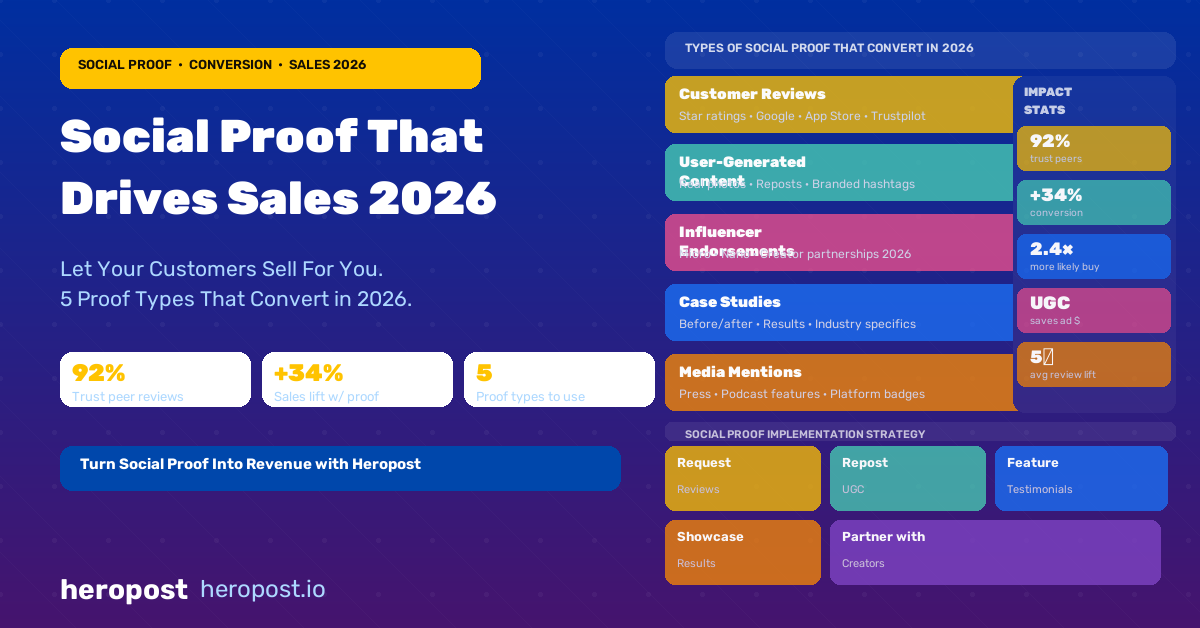
Customer testimonials
Written statements from satisfied customers about their experience. The most effective testimonials are specific (they describe the problem, the solution, and the concrete outcome), recent, and from customers who resemble your target audience.
User-generated content (UGC)
Photos, videos, and posts from real customers showing your product or service in use in their real lives. UGC consistently outperforms brand-produced content in conversion tests because it is inherently authentic — it is a real person, in a real context, choosing to share their experience.
Case studies and before/after results
More detailed than testimonials — a narrative account of a specific customer’s journey from problem to solution. Case studies are particularly effective for complex, high-consideration purchases where prospects need to understand both the process and the outcome.
Star ratings and review counts
“4.8 stars from 2,847 reviews” is one of the most powerful five-word phrases in marketing. Aggregate review data — displayed prominently in social media content and ads — provides instant credibility.
Influencer and expert endorsements
Third-party credibility from someone the audience already trusts. The key is authentic fit — an endorsement from someone who genuinely uses and values your product, as opposed to a transactional promotion, carries disproportionately more weight.
Press mentions and awards
“As seen in” and “Award-winning” signals borrowed credibility from trusted institutions. Media logos and award badges build trust especially effectively with new audiences encountering your brand for the first time.
Customer counts and community size
“Join 250,000 marketers who use Heropost” — volume signals build confidence. Large numbers communicate both social validation (many people have made this choice) and implied durability (a brand with hundreds of thousands of customers will be here tomorrow).
Collecting Social Proof Systematically
The brands with the strongest social proof archives are the ones who collect it systematically rather than waiting for it to arrive organically.
Post-purchase review requests
Automated email sequences triggered after purchase or after a customer has had time to experience the product are the most reliable way to build a consistent review stream. The timing matters — asking too early (before the customer has experienced value) yields poor reviews; asking at the right moment (after the first “aha” moment) yields enthusiastic ones.
Social media monitoring
Set up monitoring for your brand name, product names, and relevant hashtags. When customers post about your product unprompted, that is your best UGC. A monitoring platform that surfaces these mentions allows you to respond, thank the poster, request permission to reshare, and add their content to your social proof library.
Dedicated UGC campaigns
Run campaigns that actively invite customers to share their experiences: branded hashtag campaigns, photo contests, “show us your setup” or “before/after” challenges. Provide clear guidance on what you are looking for and make participation easy and rewarding.
Customer interviews
Proactively reach out to your most enthusiastic customers for short video or written interviews. The depth of insight these generate — specific outcomes, specific numbers, genuine emotion — makes them more valuable than star ratings alone.
Amplifying Social Proof on Social Media
Collecting social proof is only the first step. Amplifying it systematically across your social media channels is where the conversion impact happens.
Dedicated testimonial posts
Create regular posts that feature a single, specific customer testimonial with their photo (with consent) and name. Present it as a story, not a sales pitch: “Sarah runs a 3-person marketing agency. Here is what happened after she started using Heropost.”
UGC reposts and feature series
Create a recurring series that features customer content — “Client Spotlight,” “Customer of the Week,” “Community Showcase.” Tag the featured customer and acknowledge them genuinely. This creates a positive feedback loop: featured customers share the post with their own audience, your brand gets additional reach, and other customers are motivated to share content in hopes of being featured.
Before/after content
Before/after transformation content is among the most-shared formats on social media because it is concretely compelling — it shows change rather than describing it. For products and services where transformation is measurable (fitness, marketing results, financial outcomes, home renovation), invest in systematic before/after documentation.
Highlighting numbers in ads and sponsored posts
When running paid social content, incorporating social proof metrics dramatically improves performance. “Join 500,000 customers” in an ad headline typically outperforms feature-focused headlines. Test social proof in ad creative.
Pinned posts and bio highlights
Instagram Story Highlights dedicated to customer results, a pinned LinkedIn post featuring your strongest testimonial, a pinned tweet with a compelling customer quote — your most impactful social proof should have permanent, prominent placement.
Using Social Proof Throughout the Funnel
Social proof works differently at each stage of the customer journey:
Awareness (top of funnel): Social proof that signals scale and credibility — customer counts, press mentions, notable clients. The goal is to make a new prospect receptive to learning more.
Consideration (middle of funnel): Specific testimonials and case studies that address the objections your prospects most commonly have. If the most common objection is price, show the ROI a customer achieved. If it is complexity, show a customer who found it surprisingly easy to implement.
Decision (bottom of funnel): Granular, specific proof — exact numbers, verified reviews, before/after results — that gives the prospect the final confidence to purchase. This is where detailed case studies and video testimonials are most effective.
Conclusion
Social proof is not a nice-to-have in social media marketing — it is the primary driver of conversion for brands that have more than a handful of customers. Systematise its collection, curate it strategically, and amplify it across every stage of your social media funnel. The brands that do this well create a compounding competitive advantage: the more customers they have, the more social proof they collect, the more effectively they convert new prospects into customers.